 Skip to content

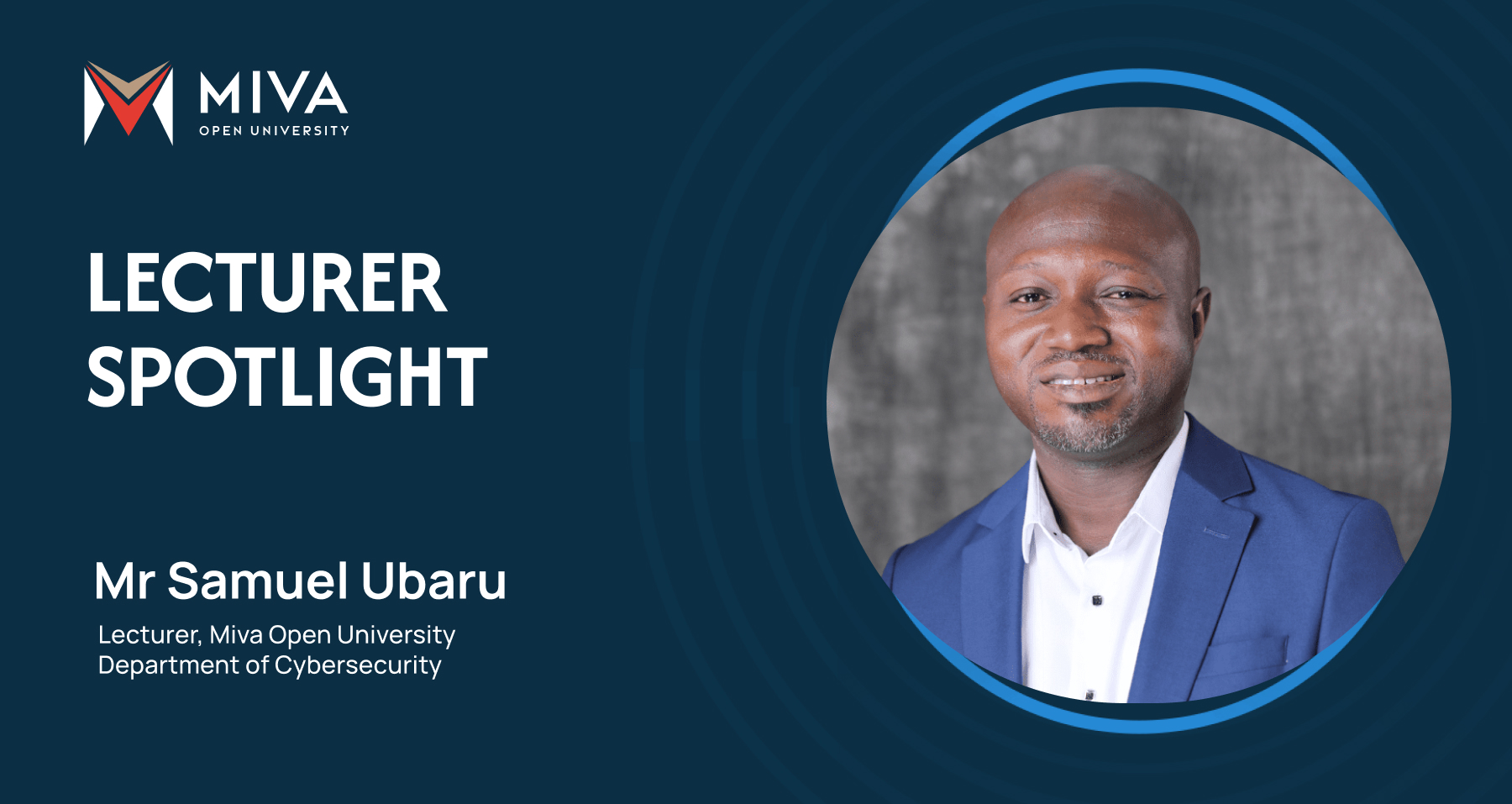
Behind every strong cybersecurity programme is someone quietly asking the uncomfortable questions: Is this current? Is this practical? Will this work in the real world? At Miva Open University, Mr Samuel Ubaru is one of those people.
As Programme Coordinator and Acting Head of Department for Cybersecurity, he sits at the intersection of industry practice, academic rigour, and forward-looking research, with a healthy respect for both evolving threats and evolving learners.
In this spotlight, he talks about bridging the gap between theory and practice, why relevance in cybersecurity is non-negotiable, how patience beats panic for beginners, and why teaching—at its best—is proof of understanding. Let’s dive right in.
In This Post
I really would like to be remembered as an educator who builds confident, ethical, and globally relevant cybersecurity professionals. I want to produce graduates who not only secure systems but also contribute positively to society.
The Academic Lore Drop
Can you tell me about yourself and your academic and professional background?
My name is Samuel Ubaru. Currently, I’m the Programme Coordinator for Cybersecurity and the Acting Head of Department for that programme here at Miva Open University. I’m currently pursuing my doctorate in Cybersecurity at NOUN.
I’ve had a mixture of both academic and professional backgrounds in computers and in the cybersecurity space. I’ve worked both in academia and in the industry. I have a BSc in Computer Science and Information Technology from Igbinedion University, Okada. I hold a master’s degree in Computer and Information Systems Security from the University of Salford in Manchester.
I’ve also had the privilege to partake in advanced training and research work in the cybersecurity space, dealing with secure systems and emerging digital threats. I work with the EC-Council; I’m a Certified Ethical Hacker and also a PRINCE2 certified professional. Professionally, I’ve worked in academia and also in the field consulting for organisations and multinationals before coming to Miva to settle fully in the academic space.
What I’ve been doing, even in my time in previous institutions, is developing skill sets for learners coming into the cybersecurity space—what they need for education, research, and curriculum development, and how they can apply this in the field.
My goal in the cybersecurity space in academia is to bridge the gap between what learners are taught and what they need to deliver when they get into the industry. I have close to 20 years of experience in this space, working in ethical hacking, network and web security, cyber threat analysis, and integration of AI into cybersecurity solutions. These are the areas of interest that have taken up my time in academia.
Are there any specific qualifications or certifications you are most proud of, and why?
Certifications I really enjoyed earning include my ITIL and PRINCE2 certifications. Adding the Certified Ethical Hacker certification was like icing on the cake. It gives me the edge that confirms I’m in the cybersecurity space.
Effective Learning and Non-Negotiables
What do you believe makes learning truly effective?
Learning becomes truly effective when students understand not just what to do, but why they are doing it. They must understand the rationale. I come from the industry, so it’s not just about talking; it’s about doing. It goes beyond imagining solutions to implementing them. So learning becomes effective when my learners can exhibit the capacity to solve problems following the principles that I have taught them.
My teaching is designed so students can deduce, apply, build, and improve on knowledge. We use real-world examples, labs, simulations, and case studies. When students can connect classroom concepts to real cyber incidents, threat analysis, defence, and vulnerability assessments, then my job is done. Learning is effective when learners can implement what they’ve learnt.
That;s true. What’s one teaching principle you never compromise on?
Relevance. Cybersecurity education has and must always reflect real-world reality. I cannot teach outdated systems like Windows XP defence. Modern systems and technologies must be taught. We must stay ahead to provide secure networks and services. Outdated knowledge in cybersecurity is not just ineffective; it’s actually a danger to us, and we don’t want it.
Miva puts you in this place where you just need artificial intelligence to assist you in the development of what your task is. Sometimes it puts the pressure on you to learn, which is a good thing. It depicts what a university should be. I call it the Miva ecosystem.
What Makes Teaching at Miva Unique
What excites you most about teaching at Miva Open University?
Miva is a very unusual platform. I’ve always had the privilege of walking into classrooms and physically interacting with the learners and teaching them. Here at Miva Open University, the task is to anticipate the possible questions that learners might want to ask you and then start providing those answers in advance because lectures are pre-recorded and learners can access them at a time that they choose, in addition to live lessons.
What excites me the most is the opportunity to actually build a cybersecurity programme that is actually flexible, inclusive, and industry-aligned.
Also, I’ve been privileged to attend programmes with other professional organisations and see what kind of services they render. Miva gives me the platform to compete, to bring my own solutions and my own version, my own ideas and write solutions in the educational space that can compete anywhere in the world.
How does it feel to work in Miva’s AI-forward environment?
I must say, it actually provides a very competitive advantage to any lecturer who is privileged to work at Miva. To be honest, here at Miva, we are basically using every cutting-edge technology that comes into the space. We are adapting and adopting new approaches to ensure that they improve our work and service delivery.
Unlike other conventional universities, you are given the liberty to adapt or adopt AI at your own pace, on your own terms. But Miva puts you in this place where you just need artificial intelligence to assist you in the development of what your task is. Sometimes it puts the pressure on you to learn, which is a good thing. It depicts what a university should be. That’s the Miva environment. I call it the Miva ecosystem.
I’m keen on building intelligent systems that can identify, analyse, and defend against cyber threats in real time.
Practical Teaching and Research
How do you connect your professional experience to your lectures?
With the real-world experience I have, I am coming to class to lecture, and I am teaching my students. What I tell them is not theory or just concepts. I am telling them about the application of the concepts, examples and real-world scenarios. It gives our learners here at Miva Open University a huge platform to broaden their knowledge and horizon when it comes to learning everything that has to do with cybersecurity.
So we are bringing in practical examples, real-life scenarios, and case studies. Some of them we handled personally, and we can also put them in the open before our learners and say, “Given all we have learned and these concepts that we have applied, are there ways we could have done things better? Are there ways we can improve on it?” At the end of the day, I believe that my learner, when faced with such situations, is better equipped because he has learned about something like that before engaging with it.
Are you currently working on any research projects?
Yes. My current research is on cyber threat intelligence using AI. I’m keen on building intelligent systems that can identify, analyse, and defend against cyber threats in real time. I’m working on multiple papers in this area.
The Cybersecurity Starter Toolkit
What practical skills should cybersecurity students develop?
Oh, very good. Cybersecurity provides services to every other arm of computing. For example, when you talk about computing, and you talk about information technology, you talk about networks: connecting systems together. Now, cybersecurity talks about how to secure that channel of communication between point A and point B.
When you talk about computing, you also talk about developing applications or developing devices like a laptop. Cybersecurity talks about how to secure that laptop and the information in it. So anybody coming in to studying cybersecurity should be open to understanding how computer networks operate, how hardware is encoded and contained, and how software is designed. A basic understanding of programming, networking, and hardware maintenance would help.
What qualities do you look for in students?
Eagerness to learn, curiosity, discipline, and integrity. Students should be hungry for knowledge and ethics in applying skills. Discipline and integrity are also critical in cybersecurity. I want learners to be ambassadors of the university, not misuse their skills.
What advice do you give beginners in cybersecurity?
Learning cybersecurity can be daunting at the beginning. There are so many terminologies to learn. Usually, my advice is to be patient. You will get it. It will become like your second language if you give it time. Patience is important in cybersecurity. You might not get it right the first time, but keep at it. Like I tell my learners: if you fail the first three times, you’ve learned three different ways not to get it wrong. You’ve learnt three different ways to avoid getting it wrong. So it’s not like you didn’t learn anything. You still learn. So keep at it. Be patient because you’ll get it right.
Cybersecurity also favours learners who pay attention to detail. You have to be observant enough to identify gaps and know how to take advantage of them.
I enjoy sci-fi movies because they help expand the imagination. I still believe humans can fly; we just haven’t discovered how yet.
The Teaching Inspiration, Hobbies, and Impact
What inspired you to become a lecturer?
My father was a professor of Computer Science, so the apple did not fall too far from the tree. He always said you don’t truly know something until you can teach another person. I teach because what I’m after is that you know it. If you don’t know it, then it means I’m not sure I know it.
That idea became my driving force in teaching. I lecture because I want my students to truly understand what they’re learning. When they succeed, apply the knowledge, and receive recognition for their competence, it gives me pride and motivation. For me, teaching is about sharing knowledge, shaping others, and empowering the next generation.
What do you enjoy outside of work, after 9-5?
Academics is a never-ending process—that’s one thing I always like to make clear. There’s really no nine-to-five in academics. Inspiration can come at any time. I could be reading or trying to write a paper or publish an article, get stuck, take a break, and still be thinking about it. That’s why I always keep a notepad with me wherever I go, so that whenever an idea comes, I can quickly write it down and work on it later.
For my leisure time, I watch movies and take long walks—I really enjoy that. Driving is also something I like to do, though I don’t really consider it a hobby anymore, especially since it’s not always safe. I enjoy sci-fi movies in particular because they help expand the imagination. I still believe humans can fly; we just haven’t discovered how yet.
So yes, my hobbies include table tennis, walking, watching movies, and driving, preferably in safe spaces.
What legacy would you like to leave as an educator?
I really would like to be remembered as an educator who builds confident, ethical, and globally relevant cybersecurity professionals. I don’t know if I’m fully on that path yet, but I have about two or three students from the previous universities where I lectured before joining here who developed an interest in studying cybersecurity after encountering what I had to offer. They are now working in that space and often reach out to say, “Thank you for the foundation you gave us.”
That is very important to me. I want to produce graduates who not only secure systems but also contribute positively to society—people I can look back on and say, Yes, these are my products. In the same way, I have mentors today who, when they are in professional forums or meetings and need someone strong in cybersecurity to handle an issue, confidently recommend me. Seeing that confidence assures me that I am on the right track in building the next generation of people I can proudly call my protégés and products.
My goal is to establish a strong cybersecurity community here at Miva Open University so that even when I leave as Head of Department, people will still remember and say, “When Dr Sam was HOD here in cybersecurity, these were the structures and legacy he put in place.”
Any final message to students?
I’ve shared a lot already, but I want to end by emphasising one key thing to our learners: patience is essential. Cybersecurity is a serious field, and the learning process can feel overwhelming at times, especially because of the volume of resources available to you.
We’ve built strong partnerships and gathered extensive training materials from leading organisations like EC-Council, Cisco, and Amazon Web Services. These resources cover cybersecurity, networking, and cloud security, and they are all accessible to our students. I even take some of the refresher courses myself to stay updated.
My message is simple: if you are truly serious about becoming a cybersecurity professional, then Miva Open University is the right place for you. Everything you need is here—just take it step by step, stay patient, and keep going.
In Conclusion
What comes through clearly after speaking with Mr Samuel Ubaru is that, for him, cybersecurity education is not simply about producing skilled technicians—it’s about shaping responsible professionals. Competence matters, but so do ethics, discipline, curiosity, and the ability to keep learning long after the lecture ends.
He measures success less by titles and more by outcomes: students who can solve problems, defend systems, think critically, and contribute meaningfully wherever they go. Or, as he puts it, the real satisfaction is being able to look back and say, “Yes. These are my products.”
With his focus on real-world relevance, AI-driven research, and industry-aligned teaching, he is not just teaching cybersecurity at Miva; he is building a pipeline of future defenders. And if his students take his advice—be patient, stay curious, be ethical, and keep practising—they’ll be more than ready for what’s out there.