
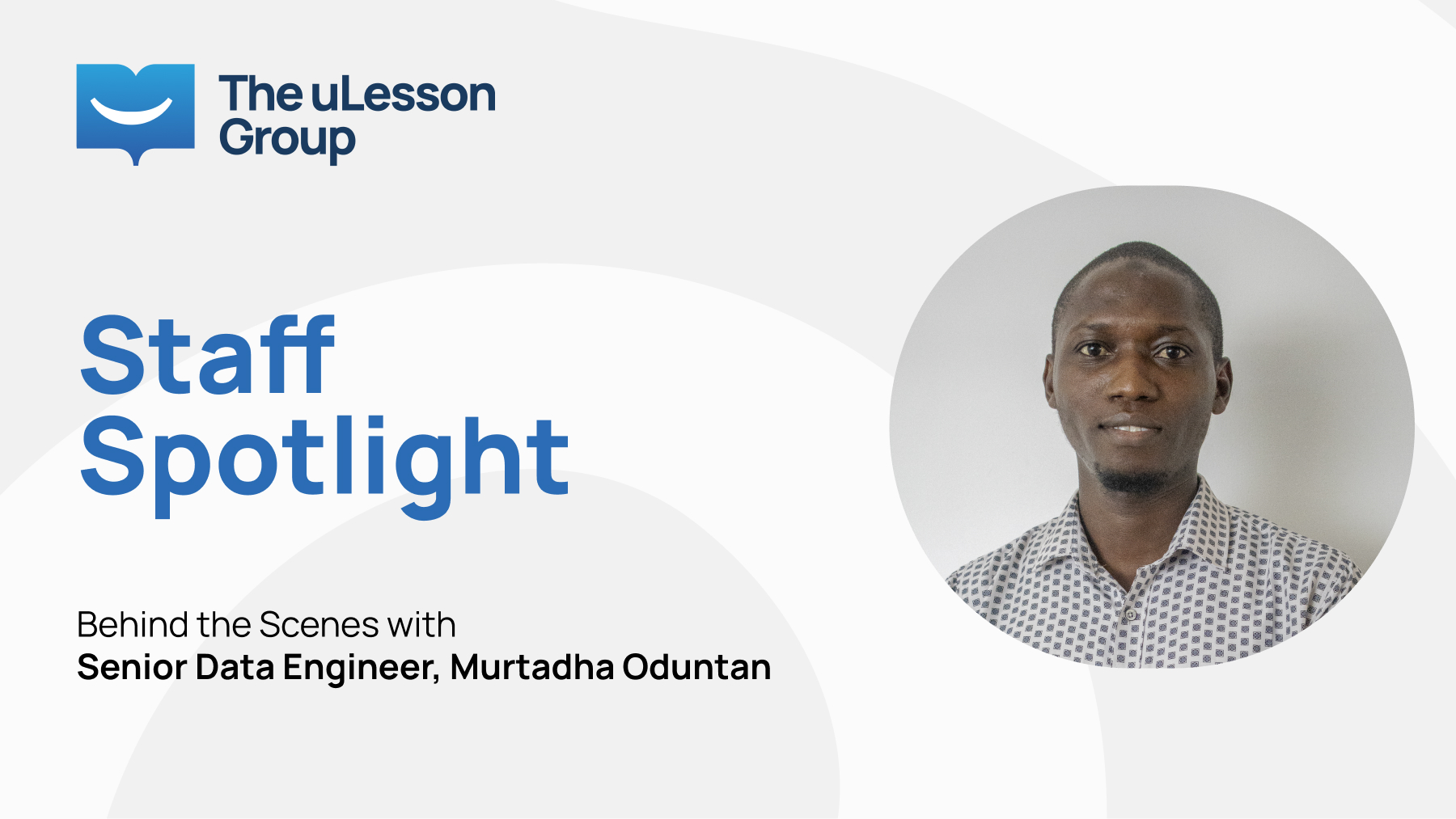
At every great company, there are people quietly making sure the numbers make sense, the systems run smoothly, and the rest of us can actually understand what’s going on. At the uLesson Group, one of those people is Murtadha Oduntan—Senior Data Engineer at Miva University, unofficial debugging specialist, and, by his own description, something of a data plumber.
From building pipelines and dashboards to fixing problems across teams, Murtadha plays a key role in helping the organisation see what’s happening behind the scenes. In this Staff Spotlight, we sat down with him to talk about his work, his love of solving problems, the story behind the Miva check-in system, and why he thinks the data team are the “eyes” of the company.
In This Post
The Data Engineer and the Data Team
In a few sentences or however you want, please tell us about yourself and what you do at the uLesson Group.
My name is Murtadha Oduntan. Officially, I’m a senior data engineer at the uLesson Group, Miva Open University specifically, but realistically, in terms of my day-to-day activities, I am more of a data platform engineer and debugging expert. I basically do data engineering, I lead the analytics team, and I also work with the product team. When it comes to debugging problems across boards, I’m always involved one way or the other, so my role is beyond just a data engineer here at the uLesson Group.
Which team specifically are you on, and which teams do you work with for your tasks?
I’m on the data team, which is under the business operations department. I work with almost every other team, from academics to product.
The product team is like my next-door neighbour because we work very closely. I work with academic operations; the content team most times—review what they’ve done, extract data on the contents, and try to see what students or learners are doing.
I work with the learner experience team also. I work with the finance team. They reach out when they need me. I also work with the corporate service team because I built the Miva check-in system, and whenever there’s any problem, they reach out to me.
I also know you work with the marketing team; your team works with the marketing team as well.
Yes, yes. Actually, I forgot to mention. Yes, I work with them. Interestingly, we usually share the same office space, like back in Abuja, and we still talk and discuss.
What’s one challenge you’ve had to go through since joining the uLesson Group, and how did you overcome it?
I would say communication strategies. I’ve always been a fan of effective communication; tell me what you want, and tell me what is happening. If there’s a problem on my end, I tell whoever needs to know.
One thing I’ve grown through since I joined the uLesson Group is how to manage communication itself: who needs to know at the right time. Sometimes I shared things in general channels when I should have spoken to one person directly. I’ve learned to understand who needs what information and when.
What do you do differently now regarding communication?
What I do differently now is I try to understand what each person prefers in terms of communication. Some people prefer one-on-one messages, some prefer channels, some prefer GChat, and some prefer Slack. I prefer GChat. You just need to understand the person you’re working with and give them what works for them.
The “Eyes” of the uLesson Group
Now, coming to your department. You’ve told us what you do, generally; what does the department actually do, and how does that connect to the picture of what we do at uLesson and Miva?
The data team is like the eyes of the uLesson Group. We make you see what’s happening. We build reports, we build dashboards, I build pipelines—I call myself the plumber who builds stuff and fixes stuff. You want to see application sources, enrolment numbers, and timelines? We build those things so you can see them. In summary, we are the eyes.
If someone joined your team tomorrow, or even today, what’s the first piece of advice you would give them?
Understand the problem you want to solve before you start solving the problem.
That’s very simple and direct, but actually very important. That way, you aren’t running helter-skelter for something, and then you’re not solving anything.
Next question: What’s something you wish more people understood about the kind of work your team does?
Data is important. Don’t just do stuff without understanding who is going to use the data at the end of the day. It’s important that we collect data and take care of the data; it’s also important that we understand the person that will use it.
What’s one feature or solution your team worked on that made a real difference for users?
One feature my team has worked on that made a real difference for people is the Miva check-in system. Almost everyone who engages with the uLesson Group and comes to our facility uses that system. I built it using Lovable AI, and then the product team helped tweak it.
We also build reporting systems that make reports easier for stakeholders. We also built a VIVAS ETL process that helps success advisors pull student data directly from the warehouse in real time.
The “Why” and Drive
Is there any moment that made you think, “This is why I love my job”?
I think I love my job, not just for one moment. I think I love my job because I love what I do. It’s part of me. I can’t really think of one moment. The moments that make me feel like I love my job are when I do things that make me solve problems every time. I just find it fascinating. So, yeah, the problem-solving drive.
What do you genuinely look forward to in your day-to-day work with your team?
The fact that I go to sleep, knowing that the next day I have more problems to go and solve. And the problems that I’m solving are impacting what we do generally. That’s one genuine drive that I have.
So, you look forward to problems every day?
I look forward to providing solutions every day.
Oh, yeah. Solving problems. Now, if your team were a TV show, what would it be titled?
If my team were a TV show, it would be titled The Artisans.
Why would you pick that?
I see my team as professionals who provide services to different individuals. I see the teams we work with as clients. Tell me what you want; I’ll give you what you want. That’s how we work every day.
What does it mean to be building something ambitious within the uLesson Group rather than working from the outside?
It’s the fact that people can see the uLesson Group and say, “I know Murtadha works there and is doing something impactful.” When I see people use the products my team builds, it gives me satisfaction. I’m happy that I can build something people use. There’s a fulfilment that comes with it.
What’s something you want students to know about the work done behind the scenes?
Something I want students to know about the work we do behind the scenes is that whatever data they enter about themselves will come back to meet them. It’s garbage in, garbage out. If you give wrong information, that’s what the system will use.
If you give us the wrong name, we’ll give it back to you. If you give us the wrong address, we’ll give it back to you. For example, if someone enters Canada as their country, they may be charged in USD. We give you back what you give us.
That was the last question, but what is it like working with your team?
The people on my team are great. I love working with them, and I appreciate what they do. Without them, most parts of my work wouldn’t be seen because they handle what stakeholders see in terms of reporting. Shout out to Ikenna and Tobi, and Dami, who works closely with us. Shout out to Jimin and the whole business operations team. It’s great to work with them.
Any final thoughts?
Today (February 5th) is my second anniversary at the company.
Oh, congrats!
It’s the longest I’ve worked in an organisation so far, and it’s been very impactful for me. I can look back and say I did this, and I’m grateful for the opportunity.
Thank you so much for your time. Congrats again on your anniversary.
In Conclusion
From pipelines to problem-solving, Murtadha’s work touches almost every corner of the uLesson Group. Whether he’s building systems that help teams make better decisions or quietly fixing issues before most people even notice them, his role reflects exactly what he calls his team: artisans—professionals who build and refine the tools everyone else depends on.
Two years into his journey at the company, it’s clear that what keeps Murtadha going isn’t just the data—it’s the challenge, the collaboration, and the satisfaction of knowing that the systems he builds help students, teams, and the organisation move forward.
And if tomorrow brings another problem to solve? That’s exactly the way he likes it.