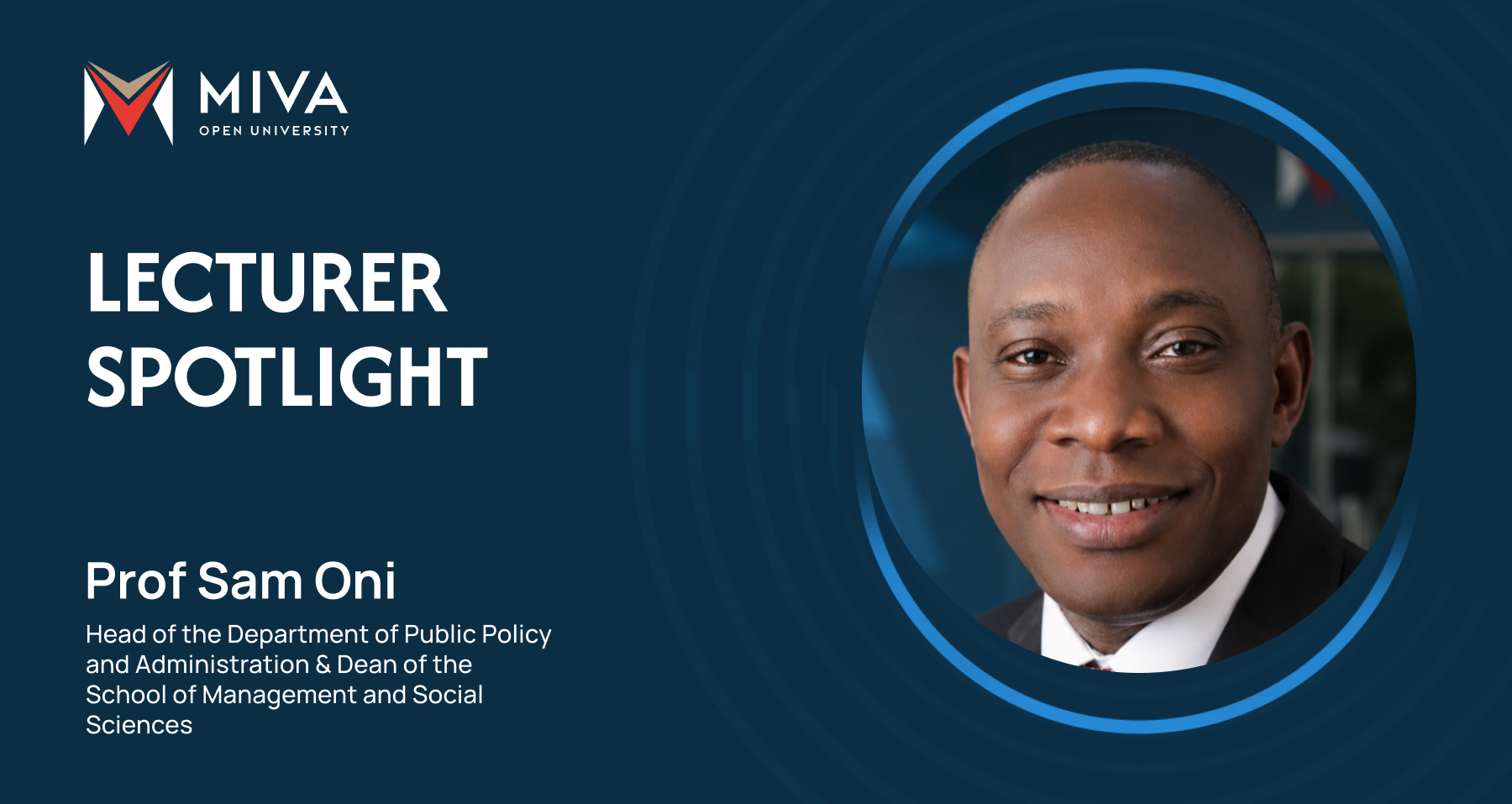
From the moment a person receives a birth certificate to the policies that shape their education, work, and quality of life, Prof. Sam Oni has always been fascinated by the systems that influence society. That curiosity has evolved into nearly two decades of teaching, research, and leadership in public policy and administration.
Today, as Dean of the School of Management and Social Sciences and Head of the Department of Public Policy and Administration at Miva Open University, Prof. Oni is committed to helping students understand not only how policies are made, but how they can be used to solve real-world problems. Through an engaging, practical, and transformative approach to teaching, he is preparing the next generation of leaders, analysts, and changemakers to contribute meaningfully to society.
In this conversation, Prof. Sam Oni shares the experiences that shaped his career, his vision for public policy education, and why expanding access to quality education remains one of the most rewarding aspects of his work.
In This Post
The Academic Lore Drop
Can you please tell us your name, your academic background, and your professional background?
Thank you very much. I’m Sam Oni, a professor of Public Policy and Administration, currently serving as the Head of the Department of Public Policy and Administration and the Dean of the School of Management and Social Sciences at Miva Open University.
My academic and professional journey has been dedicated to the study of public policy, administration, governance, development management, and institutional reforms. Over the years, I have taught, supervised, and mentored students at both undergraduate and postgraduate levels. I have also engaged in research, academic leadership, curriculum development, and policy-related consulting.
My work has focused on bridging the gap between theory and practice, ensuring that public administration and public policy remain relevant in today’s contemporary governance.
Nice to meet you, Sir. How many years have you been in the lecturing space?
It has been a journey from the very beginning. I started my academic career as a graduate assistant, then became an assistant lecturer, and progressed through postgraduate studies and academic ranks. Altogether, I have almost 20 years of academic experience.
That’s amazing.
His Spark and Teaching Style
What originally drew you to your field of study? What problem did you see before choosing this course and pursuing lecturing?
What attracted me to public policy and administration was the need to understand how governments make decisions and how those decisions affect people’s lives. Everything rises and falls on policy.
For instance, when a child is born, the first thing demanded is registration, and a birth certificate is issued. When that same person dies, a death certificate is also issued. From the beginning to the end of life, our experiences are shaped by policy.
That realisation drew me into public policy and administration: understanding how government decisions influence societal development and everyday life. I became fascinated by the role of public institutions in promoting development, solving societal problems, and improving public welfare.
So you wanted to understand what happens behind the policies that affect society.
Yes, exactly.
How would you describe your teaching style in three words?
Engaging, practical, transformative.
Why did you choose those words?
Teaching has to go beyond passing information while students remain passive. It must be interactive, so students are actively engaged in the process.
Second, teaching should move from theory to practice. It is not enough to provide theoretical understanding; learning must be practical and applicable.
Third, education should be transformative. Its purpose is to change minds, ways of thinking, and people’s capacity to contribute meaningfully to society.
That aligns with Miva’s mission of improving society through education.
Absolutely.
What do you want every student to walk away with after taking your course, especially now that Miva’s first cohort is graduating into the real world?
Beyond concepts and theories, I want students to develop critical thinking, analytical skills, and the confidence to apply what they have learned to real-world problems.
I want them to leave with the ability to ask questions, evaluate evidence, and contribute meaningfully to society and their professions.
The Miva Difference
What excites you the most about teaching at Miva Open University?
I would call it democratising access to quality education. Miva is breaking traditional barriers by making education accessible to more people.
The idea that students can learn every time and every way is powerful. Through digital learning, people who would otherwise have been shut out of quality education now have access to it. That is deeply exciting to me.
How does teaching in a digital environment influence your methods, and how do you keep students engaged in virtual classes?
Teaching online requires intentionality. In a physical classroom, you can easily observe students, but online teaching demands more deliberate engagement.
It pushes me to simplify complex concepts and use diverse learning resources. I design activities that promote active participation rather than passive learning: real-life case studies, discussion forums, group projects, collaborative exercises, and analysis of technical and policy papers. These methods help keep students involved and connected.
Do you think there are opportunities Miva gives students that are often overlooked?
Yes. One major opportunity is the development of self-directed learning skills. Students learn to manage their time, conduct independent research, collaborate virtually, and use digital tools effectively.
These are highly valuable workplace skills today. The flexibility of Miva’s learning environment also allows students to gain academic qualifications while simultaneously building professional experience.
What practical skills should students in your field focus on developing now?
Students should focus on policy analysis, research methodology, data interpretation, report writing, policy briefs, technical writing, problem-solving, and communication skills.
Research methodology, for example, is not only about writing a final-year project. It is about learning how to gather evidence and make informed decisions. I often describe this as developing strong policy analytics skills.
What trends in your industry should students pay attention to?
Students should pay attention to digital governance, artificial intelligence in public policy and administration, public sector innovation, sustainability, public-private partnerships, and citizen-centred governance.
Are these trends already integrated into Miva’s courses?
Yes. We have both integrated content and dedicated courses covering these areas. Examples include courses on administrative change management and innovation, e-governance, and technology for administrative professionalism.
Note to Public Policy Learners
What common mistakes do beginners in your field make that students should avoid?
A common mistake is assuming that public administration is only about government bureaucracy. In reality, it is a dynamic field involving leadership, innovation, strategic thinking, and problem-solving.
Another mistake is relying solely on theoretical knowledge without developing practical, analytical, and communication skills.
What qualities do you love to see in your students?
Curiosity, discipline, integrity, and a willingness to learn. Students who ask thoughtful questions and remain open to new ideas often achieve remarkable growth.
What habits separate high-performing students from average ones?
Consistency, active engagement with course materials, seeking feedback, effective time management, and taking responsibility for one’s learning. In student-centred learning, students must own the learning process.
How do you encourage independent thinking in your learners?
I encourage students to challenge assumptions, evaluate multiple perspectives, and support their arguments with evidence. Rather than simply providing answers, I pose questions and real-life scenarios that require critical thinking.
The Other Side of Prof. Sam
What do you do in your free time to relax?
I enjoy watching documentary-style films and reading to broaden my perspective. I read both fiction and non-fiction.
Are you currently working on any research or professional projects?
Yes. My current interests include governance, public sector reforms, development policy, public service delivery, digital governance, and education administration.
I am also involved in curriculum development and graduate supervision. One ongoing research area examines Nigeria’s legislature from a multidimensional and multiethnic perspective, exploring how those dynamics influence policy decisions.
What achievement in your career has been most meaningful to you?
In academia, every stage is a milestone: becoming an assistant lecturer, earning a PhD, becoming a senior lecturer, publishing in respected journals, and eventually becoming a professor.
But the most meaningful achievement has been seeing former students grow into successful professionals, academics, and leaders. Knowing that my teaching and mentorship contributed to their growth is deeply fulfilling.
If you were not in academia, what would you like to be doing?
I would still be involved in leadership, development, public service, policy consulting, and institutional development. My passion has always been helping individuals and organisations create meaningful impact.
Where do you see public policy and administration heading in the next five to ten years?
The field will become increasingly data-driven, technology-enabled, and interdisciplinary. We will see greater integration with artificial intelligence, big data, data governance, citizen engagement, economics, econometrics, and analytics.
Public policy does not stand alone; it draws from multiple disciplines to understand and solve societal problems.
Wrapping Up
For Prof. Sam Oni, public policy is more than a field of study—it is a means of creating meaningful change in society. Through teaching, research, and mentorship, he is helping students develop the skills and mindset needed to solve real-world problems and lead with impact.
Beyond academia, his love for reading and documentary films reflects the same curiosity that drives his work. As public policy continues to evolve alongside technology and innovation, Prof. Oni remains committed to preparing students to shape a better future through informed leadership and evidence-based decision-making.