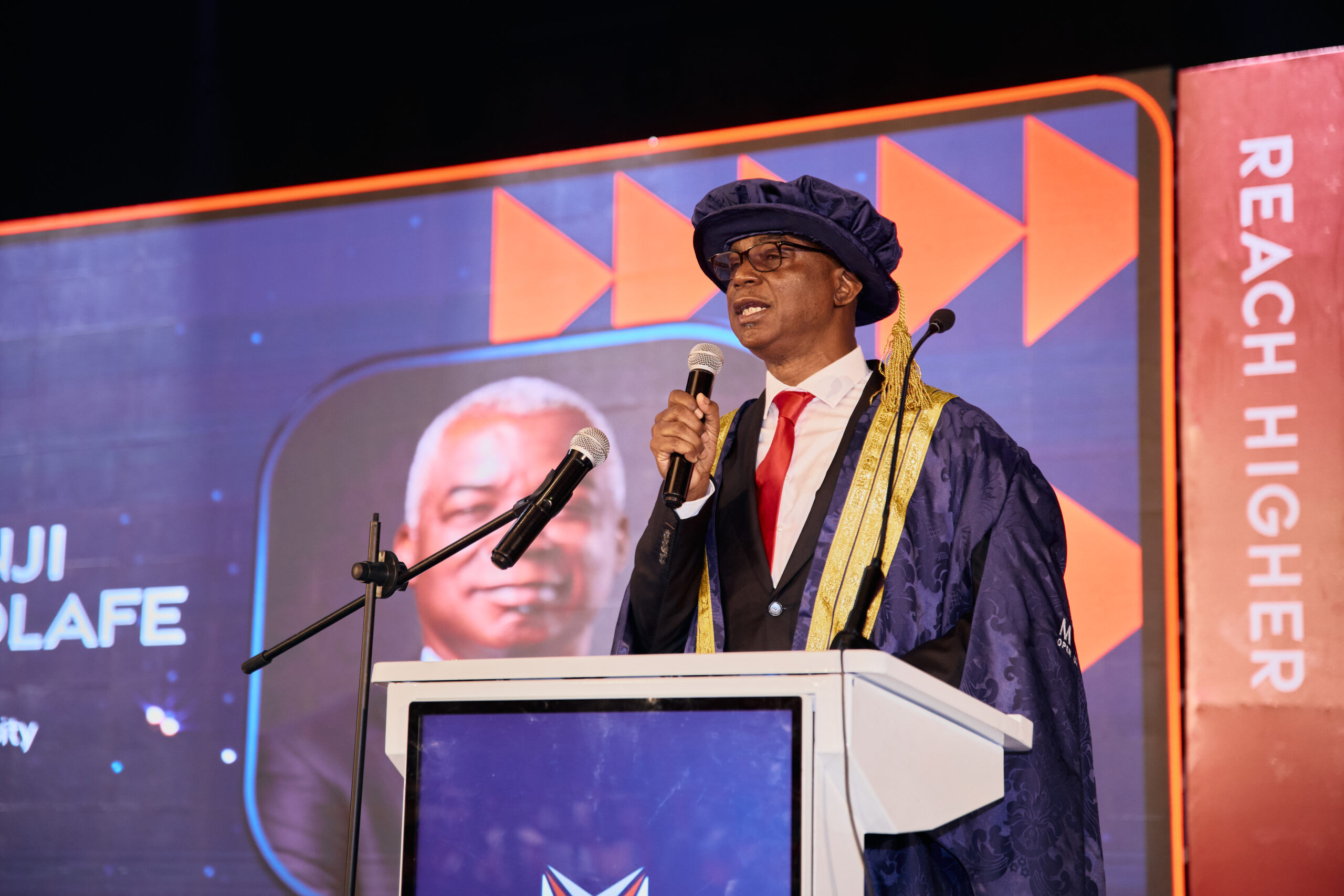
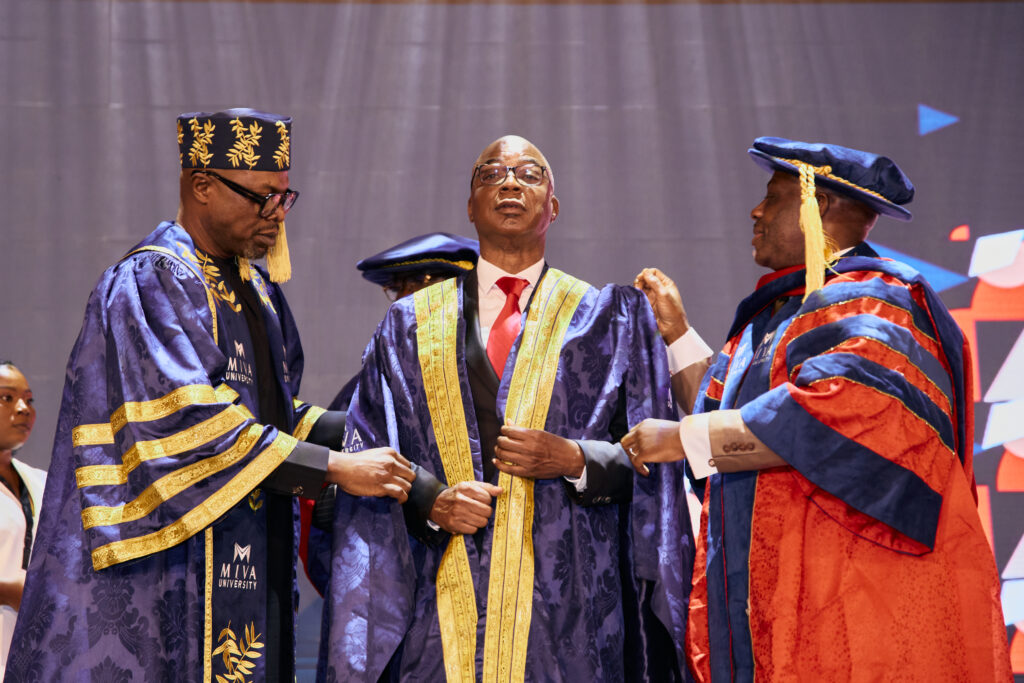
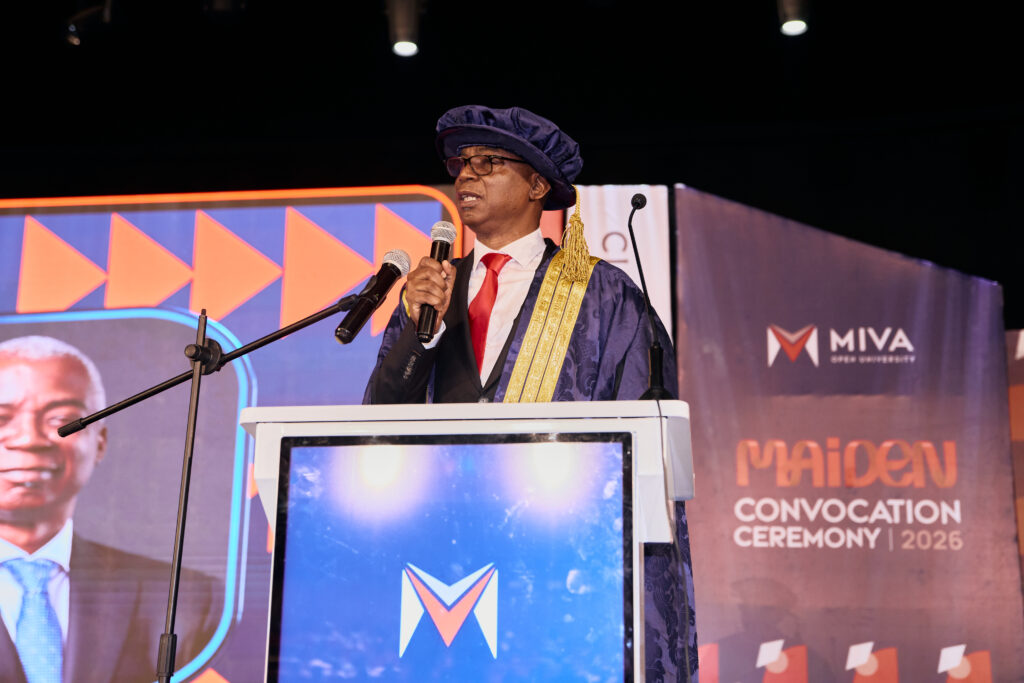
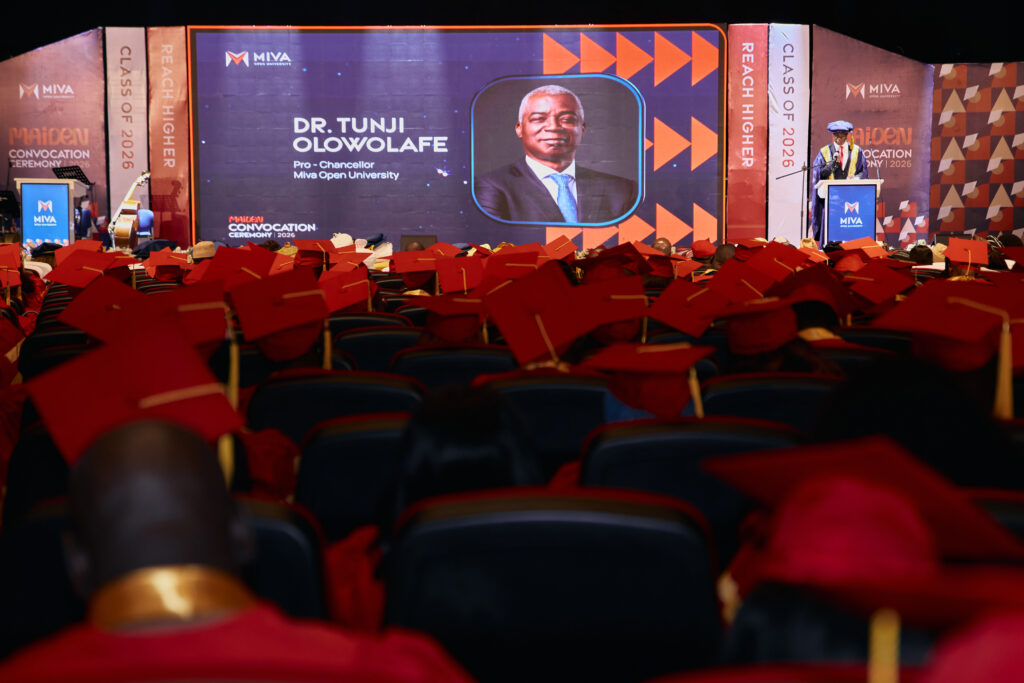
Miva Open University’s maiden convocation marked another historic milestone with the investiture of its first Pro-Chancellor, Dr Tunji Olowolafe, who delivered an address that reflected on the university’s mission, the future of higher education, and the responsibility that comes with leadership.
Speaking to the graduating Class of 2026, members of the governing council, faculty, families, and guests, the Pro-Chancellor described Miva as an institution built on the bold conviction that quality higher education should be accessible without compromising excellence. Drawing lessons from history and highlighting the transformative potential of open and distance learning, he challenged conventional assumptions about higher education while reaffirming the university’s commitment to academic rigour, innovation, and opportunity.
His address also offered a personal commitment to safeguarding Miva’s founding vision as the university begins a new chapter under its inaugural pro-chancellorship.
In This Post
The Address of the Pro-Chancellor, Dr Tunji Olowolafe
Having been invested as your Pro-Chancellor, I find myself standing before you with a weight of responsibility that is actually sobering.
I accept this office with a full heart and with rather more humility than I usually confess to having in public. I am naturally confident, but this is a big task before us. I will do my best, and together, we will succeed.
I am proud to be affiliated with and associated with Miva Open University—genuinely proud because of what this institution represents and the audacity of the idea at its founding. To Sim Shagaya and the entire team, well done. Vice-Chancellor, Governing Council, you’re all recognised.
We are here today to celebrate a first—Miva’s maiden convocation—in a building that knows something about firsts. This venue was built half a century ago for a great festival of African arts.
The building had been neglected for decades and was brought back to life only last year. It was renamed after the first African to win the Nobel Prize in Literature, Professor Wole Soyinka. There are a lot of Wole Soyinkas in this room.
I trust that among these graduates, some will return to school, and some will become entrepreneurs. The beginning of Africa is now, and I dare say there is no better place in Nigeria for this momentous occasion.
Please permit me—I’m getting a bit older now, so I have a few stories to tell.
Nearly 70 years ago, a man from a small town, Ikenne, decided that the children of the poor in his region would be educated at public expense, without any imposed limits. His name was Chief Obafemi Awolowo.
He did not stop at building schools. In 1959, he established the first television station in Africa and used it to carry lessons into homes that had no school nearby. He understood a simple truth: where students cannot travel to the classroom, the classroom must travel to the students.
Ladies and gentlemen, Miva Open University is that very idea that grew up.
Access Without Compromise
The idea behind open and distance learning is certainly not new. But in Nigeria and across Africa, it has often been treated as a lesser option—a path reserved for those who could not gain admission through the conventional route.
That framing has caused us to underinvest in a model that, if properly executed, can do more to democratise education than any other intervention we may have at our disposal.
Democratising education does not mean lowering standards. I want to say this emphatically because the two are often confused.
Democratising education means refusing to allow the conditions of learning to become barriers to the quality of learning. It means designing systems that meet students where they are, not systems that demand that students rearrange their entire lives to fit a model built for a different era.
You graduates before me today did not receive a diluted education.
You were held to rigorous standards. You were assessed, challenged, and stretched. You paid for your own data. You sat for examinations. You asked no one’s permission to be ambitious.
No one will ever be able to tell you that anything was handed to you.
I must also commend the institution for confronting, honestly, what I consider the most difficult challenge in open learning, which is quality at scale.
It is relatively straightforward to deliver excellent education to a small cohort. The difficult thing that separates a serious institution from a merely ambitious one is maintaining that same integrity as the numbers grow.
The Chancellor had mentioned a lot of numbers. Nigeria’s population is growing at about 2.7 per cent every year. The temptation, when scale increases, is to standardise in ways that strip learning of its depth.
Miva has resisted that temptation, and that is worth commending.
Chancellor again, the Governing Council, and the entire team, congratulations and very well done.
As I close, let me say a brief word about our larger national picture. An institution like Miva could not have risen in a vacuum.
These last three years have been pivotal for Nigerian education, and it is worth saying plainly and honestly in a room like this.
The current administration, under the leadership of President Bola Ahmed Tinubu, GCFR, has put real weight behind the education sector through both funding and policy. The results are beginning to show across the country.
There is much more I could say, but I will not attempt to do so because we are honoured to have with us the Honourable Minister of Education, Dr Tunji Alausa, CON, who, I’m certain, will speak to these strides in full detail.
Three Lessons for the Class of 2026
Graduating Class, congratulations once again.
There are three things I would like to leave with you today.
First, do not confuse your degree with the end of your education.
The credentials certify that you can learn. The real test is whether you continue learning throughout your life, whether you are deliberate and aggressive, without waiting for any institution to organise learning for you.
Second, your path matters to other Miva students who will come after you. They are watching to see whether this model produces people of substance and consequence.
You will be the evidence. Please carry yourselves accordingly.
Lastly, we spend a great deal of time in Nigeria lamenting what we lack.
But what Nigeria lacks most is not resources. It is organised will. It is people with training like you, people with values and the determination to build something greater than their own personal comfort.
You already have the training. We know that today marks the beginning of the will.
University leadership, this institution has demonstrated that access and excellence are not adversaries and that a new generation of Nigerians can earn a quality education without surrendering the rest of their lives.
That is the standard we have inherited. There will be pressures that will come to compromise either the openness or the quality of what we are trying to do.
My responsibility, beginning today as Pro-Chancellor, together with my distinguished colleagues on the Governing Council, is to help this university refuse any compromise.
We do not have to choose between quality and openness. We will not.
To the Class of 2026, you are not just graduates of a university; you are the first chapter of a history that has not yet been fully written.
I implore you to write it well.
Congratulations.
God bless you.
God bless your families.
And God bless our great country, Nigeria.
Thank you, ladies and gentlemen.
Conclusion
Closing his address, the Pro-Chancellor, Dr Tunji Olowolafe, challenged the graduates to view their degrees not as the end of learning, but as the groundwork for a lifetime of growth, leadership, and service.
He reaffirmed his commitment to preserving the university’s defining principles of openness, quality, and academic excellence, pledging that Miva would never be forced to choose between expanding access and maintaining high standards.
With a final charge to “write history well”, his remarks captured both the significance of Miva’s maiden convocation and the promise of an institution determined to redefine higher education for a new generation of learners.