
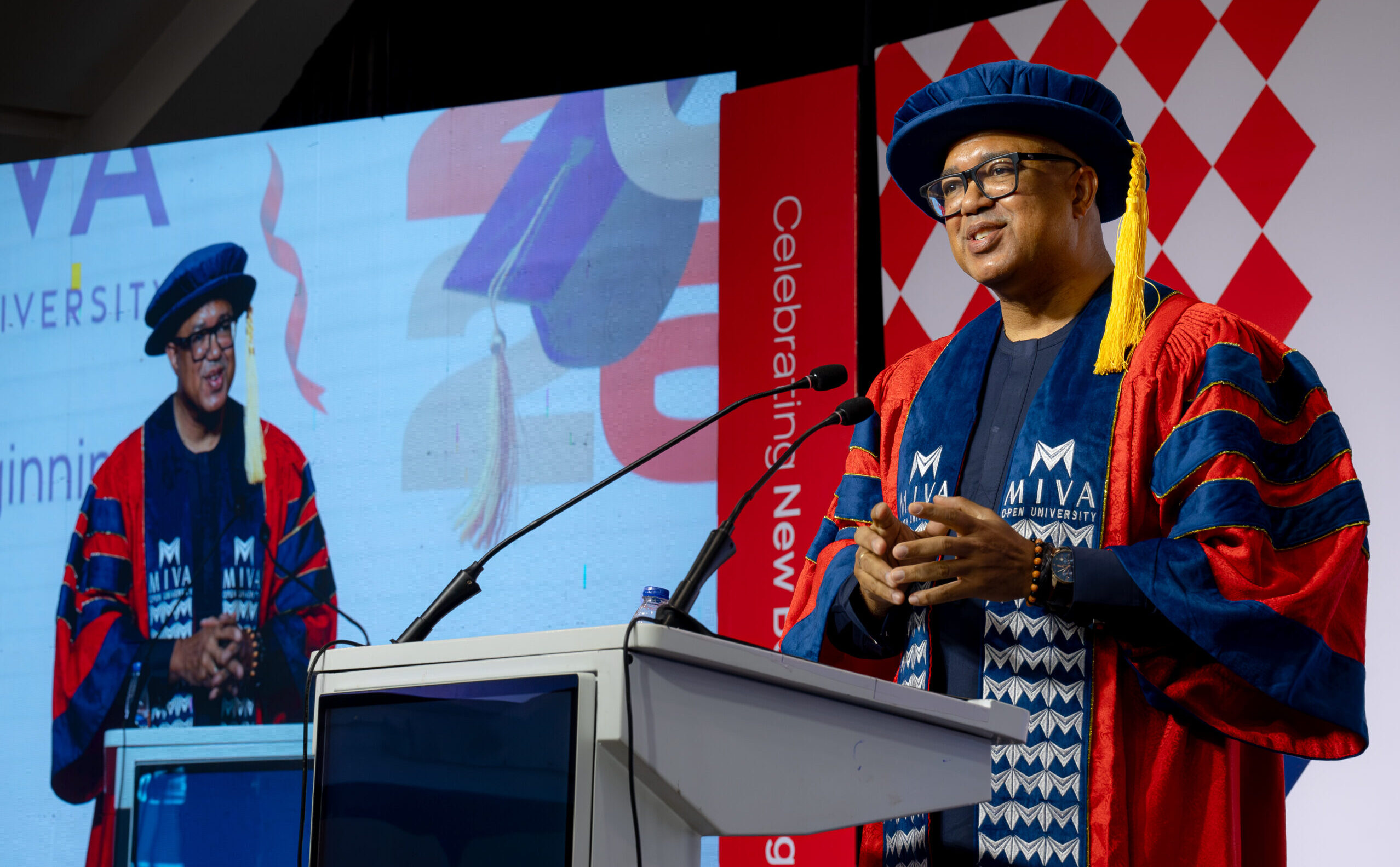
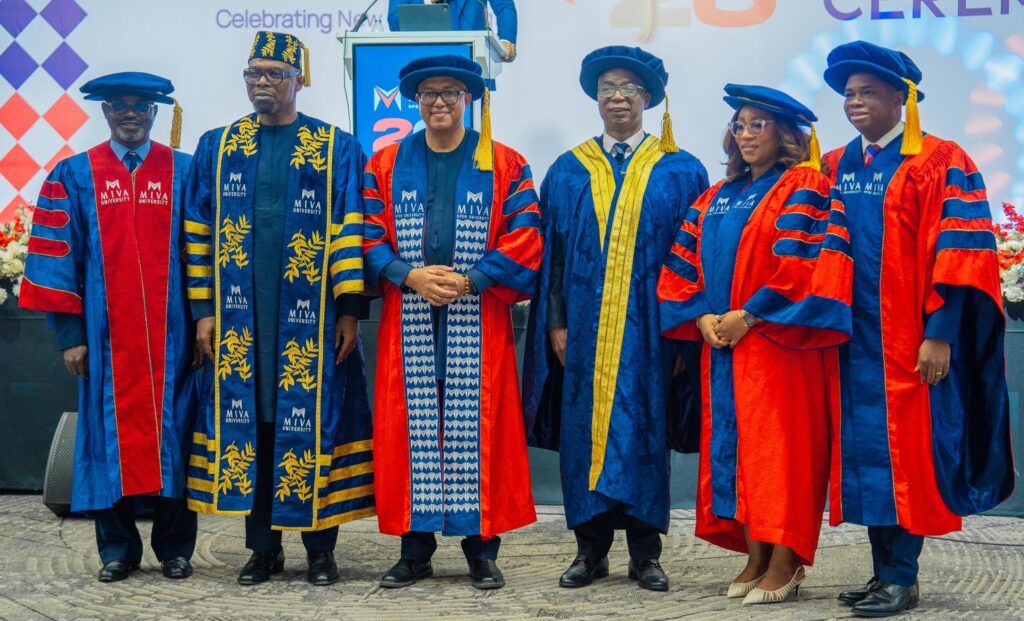
Dr Chikwe Ihekweazu, OON, Executive Director of the Health Emergencies Programme at the World Health Organisation (WHO), delivered a keynote address at the 2026 Miva Matriculation Ceremony, encouraging newly matriculated students to see university education as more than a means to earn a degree.
Drawing from his personal experiences and professional journey, he challenged the students to pursue meaningful learning, develop practical skills, and use their education to create value for themselves and society.
In This Post
The Keynote Address by Dr Chikwe Ihekweazu, OON
Thank you, Chancellor, my brother. Thank you, Pro-Chancellor, my senior colleague, Dr Tunji Olowolafe. Vice-Chancellor Professor Tayo Arulogun, staff, management, parents, and students of Miva Open University.
I’ve learned the phrase, as we say here, “Get Miva. Reach Higher.”
Firstly, thank you very much for inviting me.
Secondly, I also made a conscious decision. After five years in the public space, and after having the privilege of speaking to Nigerians almost every day at the beginning of the COVID-19 pandemic, [I decided] to take a step back from public speaking. But this invitation was personal to me.
A New Model of Education Can Expand Opportunities for Millions
I have two children at almost the same stage as many of you matriculating today. So today, I will speak to you as directly and honestly as I can and as I would speak to them.
So, dear students, let me take you back to my childhood. I am what they call in Nigeria a campus kid. I grew up on the campus of the University of Nigeria, Nsukka, where both my parents lived and worked.
On the Nsukka campus, campus life shaped everything: our friendships, our education, health, sports, social activities, and everything we did. So there’s a certain irony in my addressing you today, matriculating into a large university community without a campus in its traditional sense.
But there’s also something very powerful to it. In the 1950s, visionaries such as Nnamdi Azikiwe brought a university to the then tiny village of Nsukka and created opportunities for my parents’ generation to thrive.
Today, visionaries like Sim Shagaya and his team are using a different model to enable thousands of Nigerians and Africans to fulfil their potential through an education from Miva University. Thank you, Sim, Tayo, Lovelyn, Iheanyi, and everyone who is part of this dream. And, of course, Sim, your amazing wife, Anthonia, who is not here with you today and who I know is a big and special part of your life every day.
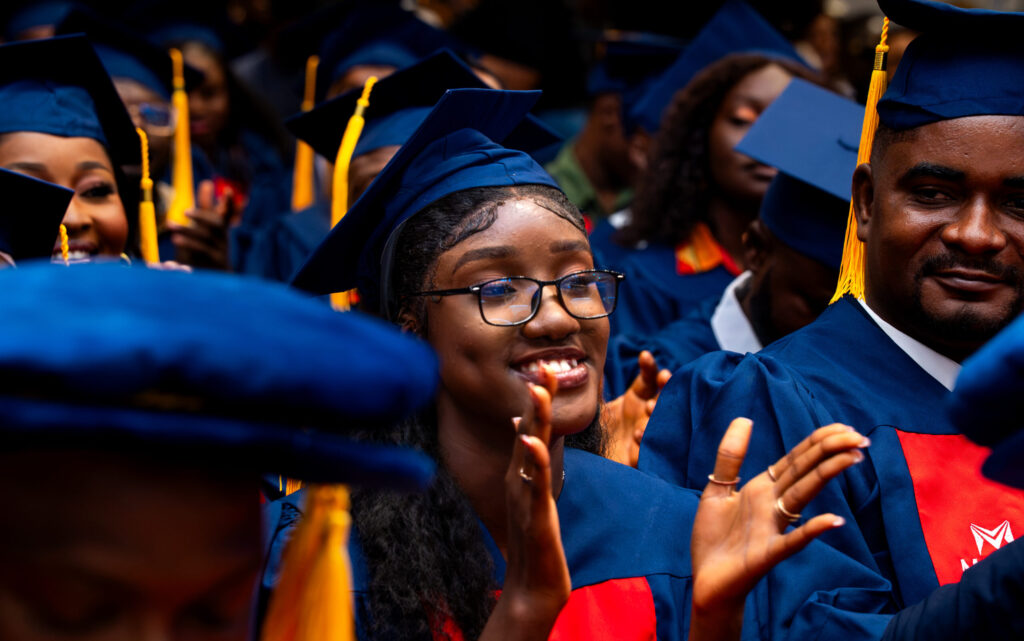
All of you are pioneers in bringing a new model of education to life, one that puts quality education within the reach of millions.
A University Degree Must Represent a Real Education
But let me begin with a story.
In early 2017, as the Nigeria Centre for Disease Control prepared to receive its first set of National Youth Service Corps members, a young man was referred to me. At the time, I was privileged to be serving as [Director-General]. I invited the young man into my office for a conversation.
He had graduated with a second-class honours degree from one of Nigeria’s leading public universities. Yet, when I asked him about his aspirations, he struggled to express himself. At first, I thought he was simply intimidated.
He was sitting in front of the DG in an office with a portrait of President Buhari staring down at him. Then I asked whether he had ever used a computer. He had, but only occasionally.
And he was not comfortable using one independently. I knew he would struggle with the kind of work we did at NCDC at the time. As he left my office, I felt deeply saddened, not by his limitations, but by the system through which he had just passed.
I thought to myself, if his experience reflected that of an average Nigerian graduate, then we’re in serious trouble. I felt that our country was failing a generation, not because young people are not getting university degrees, because many are, but because too many young people with degrees are denied the education those degrees are supposed to represent.
At the end of the day, I did give this young man a chance…and he went on to do well. At NCDC at the time, we had a well-structured programme for youth corps members, recognising not only their potential but our responsibility to them.
So, my dear young colleagues, as you begin your journeys, let me ask you one question.
Do you want to earn a university degree, or do you want to gain a university education?
These two should mean the same thing, but unfortunately, they do not always. In our beloved country, we too often look for shortcuts. I am confident that Miva has strong safeguards, but the outcome of your time here will depend not only on the university; it will also depend on you.
This brings me to another story about a visionary in education, my dear friend Patrick Awuah Jr., founder of Ashesi University in Ghana, one of Africa’s pioneering liberal arts universities.
A few years after Ashesi started, its students made an extraordinary request to their founder. They asked Patrick to allow them to sit their examinations without invigilators and promised to hold one another accountable.
The students came together and convinced the university’s management that they valued their education too much to do anything to undermine it. They would hold each other accountable for invigilating during exams and would not undermine their education by cheating.
Since then, Ashesi has conducted examinations without invigilators.
The students themselves uphold the integrity and ideals of their university. They understood that the true value of their time at Ashesi means not merely getting a degree but becoming people worthy of the degree.
Now, I can almost read your minds. Many of you are thinking, “Who education don help?” Especially in Nigeria today, many of you understandably want to find a well-paying job, maybe start a business, become rich, or maybe just japa. You may see a degree primarily as a means to that end. After all, our country today barely rewards education.
We adore celebrities on Instagram who we have no idea how they have made the money that they so openly display. But the lesson of the stories I share is that education gives you more than a route to your next destination. It gives you the capacity to create true value for yourself as a person and the context you hold dear.
Let me share another story from the NCDC.
Developing People Is Part of Building Strong Institutions
When I was appointed Director-General, very few people were aware of the agency. It had only existed for a few years, and by the time I was appointed Director-General, it did not yet have a law establishing it.
I know what some of you are thinking. But no, it was not quite like some other agencies that were in the news for a phantom director-general. I was appointed by Mr President initially as National Coordinator and subsequently as the first Director-General in 2018.
Given that we were so new, we had the opportunity to build something from the ground up. We recruited talented young people, invested in their education and development, and gave them opportunities to grow. There was scepticism, as there often is in government, about them and about me. One director in the ministry dismissed all of us as children in government.
Yet those young people helped us build one of the most forward-looking public-sector institutions of our time. We equipped staff with digital tools, ensured reliable access to power, complemented the grid with solar energy, established emergency operations centres in every state in the country, connected each of them to a national network, and much more.
Most importantly, we created a vibrant work environment with talented young people, where talented young people actually wanted to work. We called [that period] the transformation years.
So when the COVID-19 pandemic reached Nigeria, the NCDC suddenly became widely known. Many people wondered, “Where the hell did this agency come from?”
But young people did not drive this transformation alone. It also depended on the leadership of some outstanding public servants.
I invited one of them to join me today: Mrs Ilori.
I did not know her before coming to the NCDC. She was an experienced civil servant deployed by the ministry to help establish this young agency.
In truth, they may have tried to get rid of her. But she listened and believed in our mission. I believed in her ability to deliver with me. Together with her and a few others, we worked late into the night every day, building a new public-sector institution. We pushed states to take more responsibility, educated the public, and even persuaded our legislators to prioritise NCDC’s work.
Perhaps her greatest contribution, together with a few others, was mentoring and supporting our younger colleagues. I watched [her] discover a different type of fulfilment; the satisfaction of helping others achieve their full potential. I recognise that feeling, the joy of seeing someone in whom we have invested so much flourish.
And I want to say publicly, thank you, Mrs Ilori, and all the others, for your service to our country and your service to the young people we met.
Today, of the colleagues I worked with at the NCDC, 40 of them are now working across 13 leading organisations around the world. I know because I count them. They include the Africa Centres for Disease Control and Prevention, the World Health Organization, where I work, CEPI, the US Health Security Agency, the US Centers for Disease Control and Prevention, the Gates Foundation, the International Red Cross, and more.
So, despite the bad rep public sectors get in Nigeria, it must mean something that 40 [people] in a cohort of 300 competed for and got jobs in the best global institutions around the world.
In addition to the 40, many have also moved on to roles in Nigeria, got scholarships abroad, and returned, and I’m sure others will return. We can’t be that bad after all.
Plus, let me also add that beyond their jobs, they built something just as valuable: a strong network among themselves.
Long after their time at the NCDC, they continue to reach out to each other, sharing opportunities, offering advice, and cheering each other on. That network has become quite a support system, and it is a reminder that the relationships all of you are building here at Miva can carry you far beyond your time here.
I share this story not because people leaving government parastatals is in itself a good thing or something to celebrate. Strong institutions need to retain people, but institutional success is also measured by other factors.
It is reflected both in what people achieve while they are part of an institution and in the value they create after they leave. When an institution develops people who go on to [serve other organisations], it is also part of its legacy.
Many of the young people who came to the NCDC are carrying their experiences into institutions across Africa and the world, leading teams, shaping policies, building programmes, and responding to public health [needs].
For me, the people—that is one of the NCDC’s enduring legacies. We built an institution in Nigeria, and we also helped build a generation of public health leaders for the world. I could not be prouder.
Their journeys remind us that education is not simply what you receive at the university. It is what you continue to build, apply, and share throughout life.
Use AI Wisely and Don’t Lose Hope in Nigeria
Before I conclude, let me turn to one of the defining issues of our generation: artificial intelligence.
You are starting your university education and will begin your careers at an extraordinary moment. Digital learning has already placed knowledge that was once available to only a few within the reach of almost anyone with an internet connection, an opportunity I understand that Miva itself is active in leveraging.
Now, I think artificial intelligence is transforming not only how we access knowledge but also how we learn and how we work. But with that opportunity comes a profound choice. You can use these tools to deepen your learning, or you can use them to try to avoid learning altogether.
If you use AI to do your assessments to pass rather than to learn, you may actually get the grades. You may even get a degree, but you will have denied yourself something far more valuable: the education you actually came to seek.
Let me say a few words about our country, Nigeria.
Whatever you do, please do not lose hope in our country. The future we want will not be built by resources alone. It will be built by educated, engaged, and courageous citizens.
The millions of children who are out of school today and the poor conditions in many of our schools and universities are not inevitable. They reflect the choices of our political leaders about how our common wealth is used and what our country prioritises.
Whether to build coastal roads or invest in education, whether to travel in convoys of 50 cars or fix our universities, these are not [trivial] choices.
Those who make them know that education gives you the power to question their priorities. It gives you the power to demand better and create alternatives that will help lead our country, Nigeria, in a different direction.
Please do not perceive education only as a route to personal success. Use it to develop the judgement, confidence, and social consciousness to serve others and transform our society.
The future we seek for Nigeria will not be handed to us. We must build it ourselves.
Sim Shagaya and his Miva team have shown us what can be achieved when vision is matched with commitment and access.
What Nigeria is experiencing today is not without historical precedent. In the book Why Nations Fail, which I recommend you read, Daron Acemoglu and James A. Robinson explain how societies stagnate when political and economic power is concentrated among a narrow elite, and how they advance when institutions broaden opportunity and participation.
Their wider research on how institutions affect prosperity, with Simon Johnson, was recognised in 2024 with a Nobel Prize in Economics.
They showed that part of eighteenth-century Europe was also dominated by aristocracies, monopolies, and barriers that protected only the privileged. Over time, wider access to education helped more people acquire the knowledge, confidence, and collective voice to challenge the status quo and demand more inclusive societies.
Today, we look at Europe’s more egalitarian societies and imagine that they have always been that way. They have not.
Education Should Open Doors for Others, Not Just for You
Your education must therefore be more than a passport to personal comfort. It should help you understand the institutions around you, question what does not work, challenge injustice, create alternatives, and widen opportunities for others.
Your degree may open doors for you, but your education should help you open doors for others.
So, my dear brothers and sisters, as we begin these four years, I will return to the question at the heart of everything I am saying.
Are you simply here to earn a degree, or are you here to gain an education?
I hope you choose education.
Be curious. Read beyond what you are assigned. Ask difficult questions. Learn from people who know more than you. Use technology to expand your mind, not to replace it.
Build friendships and networks that challenge you. Develop expertise, but also character. When opportunities come, as they surely will, have the courage to take them, even when you do not feel completely ready.
[Also] please, do not give up on Nigeria. You have every right to be frustrated by our country’s problems, but Nigeria does not belong only to presidents, governors, ministers, and those who hold power today. It also belongs to you. Its future will be shaped by the choices your generation makes; what you learn, what you build, what you refuse to accept, who you choose to serve, and the opportunities you create for others.
You are beginning four years devoted to learning. This is an extraordinary opportunity. I urge you to embrace it with all your energy.
If you are studying a subject that you truly love, treat it as more than a course of study. Treat it as the beginning, the foundation of a vocation that will shape the rest of your life.
Learn at every opportunity. Seek out people with knowledge and experience; follow their work. Ask questions. Study deeply, but also widely. Build real expertise in your chosen field, but do not stop there.
In your generation, knowledge in a single area will rarely be enough. You will have to learn to communicate, collaborate, adapt, and solve problems. Your network, language [skills], digital competence, and technical skills will matter more than you can ever imagine.
The more you develop yourself, the more valuable you will become, not only to your employers but also to your communities, your countries, and yourself.
But let me also be practical. It is understandable to expect that after [completing] your studies, a job will naturally follow. But a degree alone rarely guarantees employment.
My wife, who’s here with me, runs an organisation that those of you studying public health should get to know called Nigerian Health Watch. She often raises this when recruiting. Candidates for jobs always have a better chance when they can explain how their skills fit into the organisation’s work and what problems they could help solve.
At entry level, very few organisations are looking only for your knowledge, even with the degree you are about to get. It will not meet that much, trust me. What they are also looking for is your value proposition: what you can offer, your skills, your aptitude, and what you can contribute.
Employers are looking for problem-solvers. Use your time here to become one of those people. You have an active role to play in preparing for that future.
Start while you are here. Seek out internships wherever you can, even short placements that give you a chance to apply what you have learnt. Seek out and attend conferences and events in your area of interest.
Ask questions. Build relationships. These experiences can help you discover opportunities and give an employer a reason to take a chance on you.
Four years from now, I hope you leave Miva with an excellent degree, but also with far more than a degree.
I hope you leave with knowledge you can apply, questions you are unafraid to ask, values you are unwilling to compromise on, and the confidence to make a difference wherever you find yourself.
Ultimately, the purpose of education is not simply to change what you know. It is to expand what you are capable of doing with your life and in the lives of others.
Your degree…may open doors for you, but your education will give you the courage, knowledge, and conviction to open doors for others.
Before I close, let me say a word to the parents, families, and faculty here today.
To the parents and families, you have brought these young people to this point with the help of your sacrifice and encouragement, I believe. Continue to support them, but give them room to discover who they are. Allow them to make mistakes, change their minds, and find their own paths. Your task is no longer to direct every step but to give them the confidence to take bold steps for themselves.
And to the faculty, you have been entrusted with something special, something very precious. Your responsibility is not simply to teach a syllabus or to prepare students to pass examinations. It’s to awaken their curiosity, demand excellence, model integrity, and help these students discover what they’re truly capable of.
Years from now, they will forget much of what you have taught them in the classroom. But they will never forget and will always remember how you challenged them, how you believed in them and opened their minds to possibilities that they could never have possibly imagined.
I wish you all the success possible on the journey ahead, but don’t forget also to enjoy the journey.
Thank you very much.
Conclusion
Dr Ihekweazu’s keynote address reinforced the importance of pursuing an education that develops knowledge, character, practical skills, and a sense of responsibility to society. He reminded the students that while a degree may open doors for them, the true value of their education lies in what they learn, what they contribute, and the opportunities they create for others.
As the new students begin their journey at Miva, his message serves as a reminder to make the most of their university experience, prepare for the challenges ahead, and remain hopeful about Nigeria’s future. By learning with purpose and applying their knowledge to real-world problems, they can contribute to building stronger institutions and a society where more people have the opportunity to thrive.