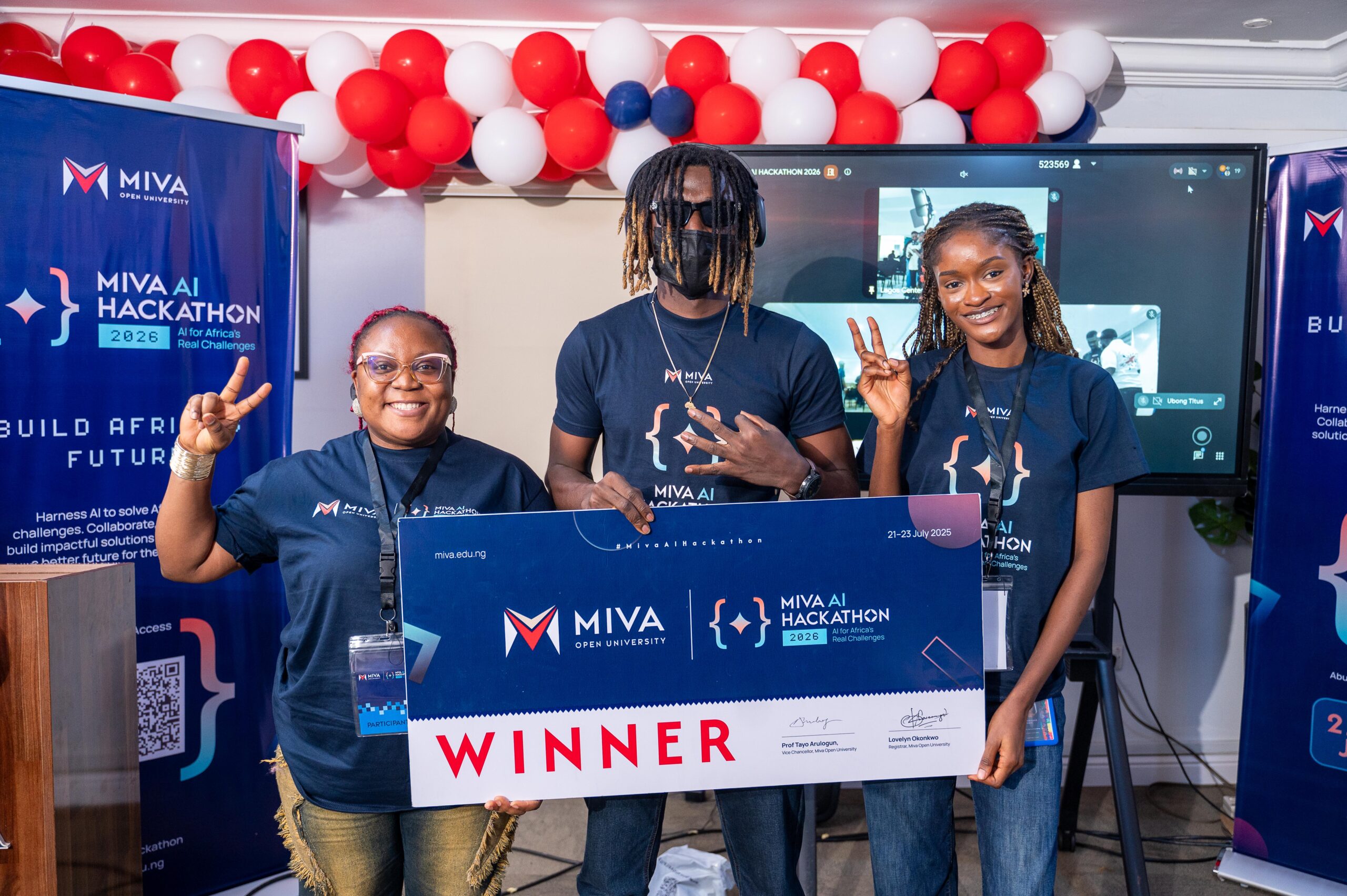
Winning an AI hackathon is one thing. Building a team that can work together under pressure, move quickly, and think beyond the competition is another. For Team Vector, the Miva AI Hackathon 2026 was more than a three-day challenge. It was an opportunity to test what they could build together and take their ambitions a step further.
Made up of students from Public Health, Cybersecurity, Data Science, Information Technology, Software Engineering, and Computer Science at Miva Open University, the team brought different skills and perspectives to the table. Their collaboration helped them turn a shared concern about hospital waiting times into Medlink, an AI-powered solution that uses WhatsApp agents to help route patients to the right doctors.
The team has renamed the product ‘Navira AI’ and is now working on a new version that incorporates feedback from the judges and others who interacted with the project. For these winners, the hackathon may have ended, but their plans for Navira AI are just getting started.
In This Post
Meet Team Vector
Team Vector brought together students from different programmes, locations, and areas of expertise, with each member contributing a distinct skill to developing Navira AI (formerly Medlink).
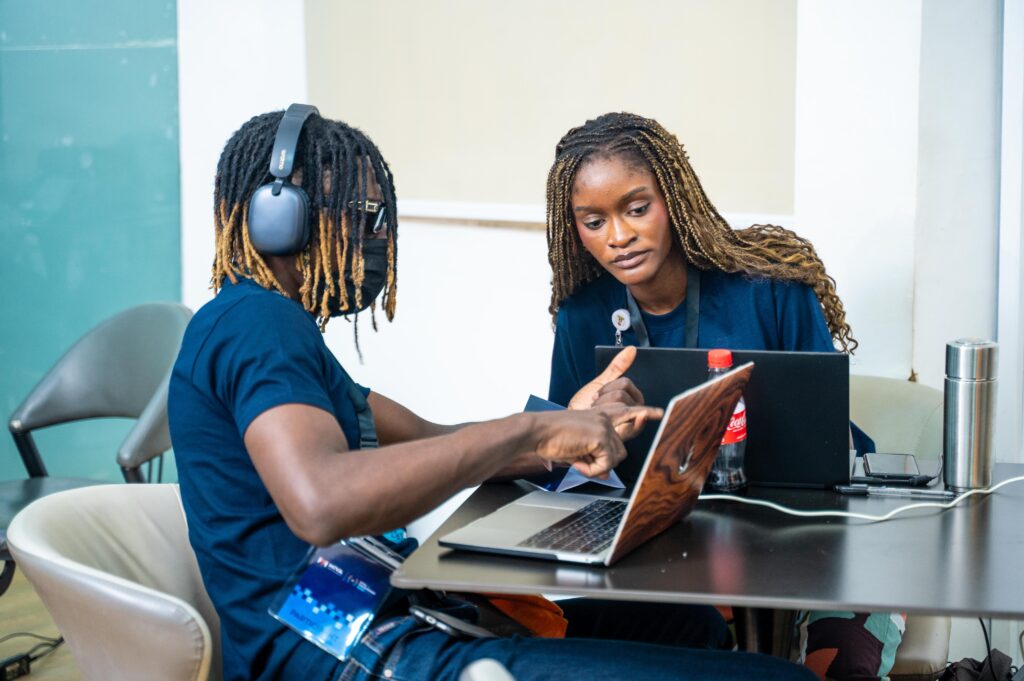
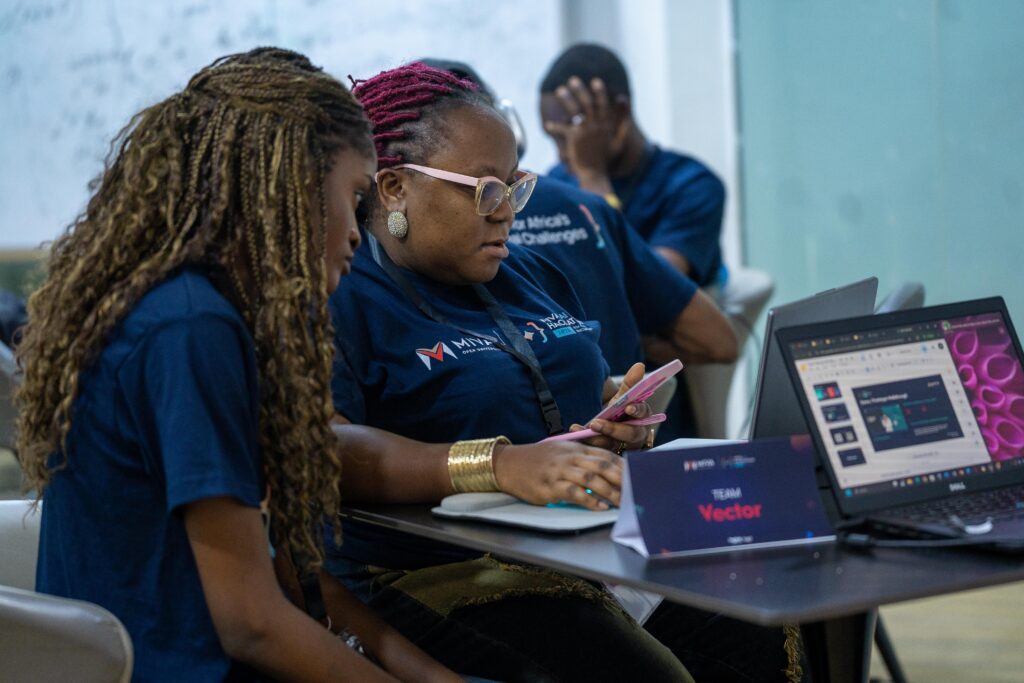
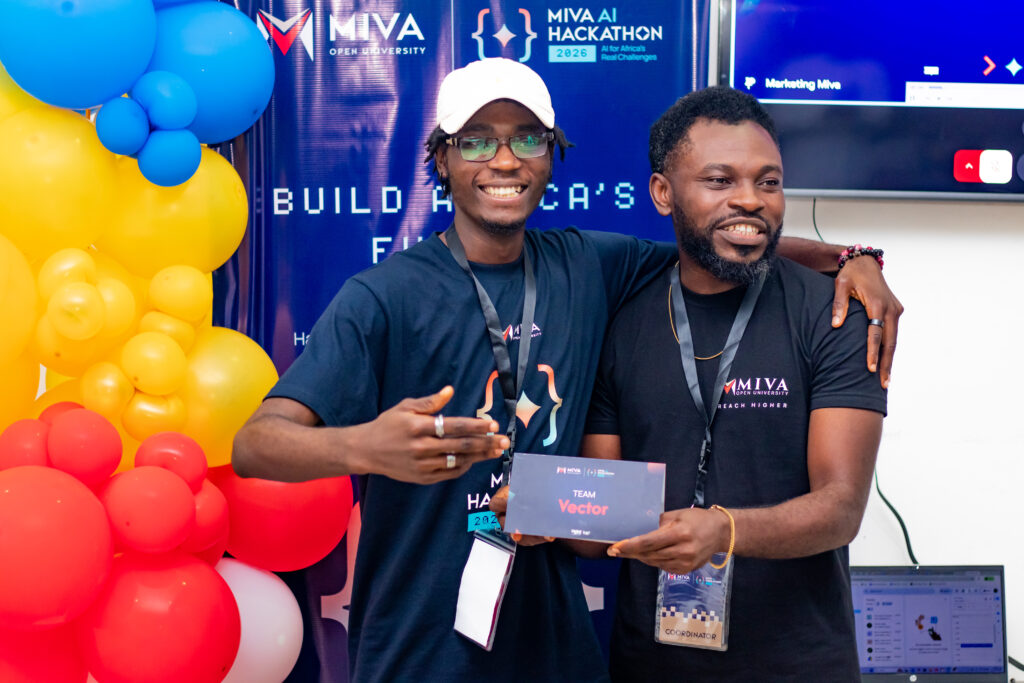
Caroline Omotayo is a Public Health student in the January 2025 cohort. With a background in data science and an interest in health technology and environmental health, she served as the team’s data scientist and spokesperson.
Abraham Covenant, a Cybersecurity student in the May 2026 cohort, contributed as a backend developer. He is interested in systems security and plans to build a career in penetration testing.
Gideon Kayode is a Data Science student in the January 2025 cohort. His career interests sit at the intersection of data, technology, and social impact, with a focus on data science and AI. He served as the team’s data and project manager.
Adeniyi Adesina, a September 2025 Master of Information Technology student, contributed to the project’s UI/UX. He is working towards a career as a product owner, with a career path in product design.
Ibinaiye Omobolanle Priscilla is a Software Engineering student in the May 2026 cohort. As the team’s frontend developer, she helped build the project’s user-facing side. Her career goal is to become a software engineer.
Ishaq Ademu, a Cybersecurity student from Abuja in the May 2026 cohort, worked as a frontend engineer on the project.
Olanrewaju Lawal is a Master of Information Technology student in the January 2026 cohort. With a career goal of becoming a senior AI engineer, he contributed to Navira AI as a backend engineer.
Miracle Eze, a Software Engineering student, joined Miva in January 2026. He worked as the team’s QA tester and is building towards a career as a software engineer.
Adeiza Fuad Garba is a Master of Information Technology student and part of the January 2026 cohort. With a career path in software engineering, he contributed to the project as a backend engineer.
Akintola Oluwaseun, a Computer Science student who joined Miva in May 2024, served as the team’s product manager. He is working towards becoming a senior product manager.
From Different Backgrounds to One Big Idea
I know a bit about your backgrounds, but I want you to introduce yourself briefly.
I’ll start with Caroline. You’re studying Public Health, and I think you have some experience in data science. Can you just tell us a bit about yourself and how that connection or switch happened?
Caroline: I’m Caroline, a data scientist and a medical professional studying Public Health. I went into data science to bridge the gap of data unavailability in Nigeria and also to change the stereotype of the data problem in Nigeria.
That’s one of the major reasons that led me to venture into data science. For me, it’s a passion built out of the unavailability of data. When you get to the hospital, instead of getting straight into care, they start asking the same questions all over again.
Let’s say I went to the hospital yesterday, and I told them my name, my dad’s medical history, my mum’s medical history, and mine, and I got treated. If I go there again today, I’ll still need to repeat the same procedure and tell them what I have and what I need to do. Why don’t we have data that gives us complete information on a patient?
Once a patient goes to the hospital, they should already have the data and history of whatever is happening with the person and just follow up on whatever treatment the person is receiving. So that’s the major thing that brought my passion into data science.
All right. And Seun, has it always been computer science for you?
Seun: Yeah, it has always been computer science from the start.
Thank you very much. So my first question: what made you choose hospital waiting times as the problem you wanted to solve?
Seun: We were looking at ideas from different tracks that everyone in the team has faced, particularly healthcare and logistics.
Then we streamlined our ideas to one problem, which is the queues in hospitals and how it affects people. During [the hackathon], there was a team member who was sick. He went to the hospital and had to wait in a queue. Those experiences gave us a problem to find a solution for.
Building a Solution Under Three Days
All right. Now, with only three days to build, what was the most difficult part of turning your idea into a working solution?
Seun: The hardest part was getting everyone to understand what we were really trying to build so that we didn’t end up building something beyond the problem we were trying to solve or beyond what we originally intended. We needed something that was feasible within the three days.
So, the challenge was figuring out what everyone needed to do and how we could get it all done within that timeframe.
How did your team decide what Medlink needed to do specifically and what features to prioritise?
Seun: We looked at the queues and how we could solve that problem. First of all, we thought of how patients and the doctors could just text each other.
Someone suggested turning the patient’s end into a WhatsApp agent. That made things much easier, and the different features started to fall into place.
Everyone suggested a feature, and we looked at which ones were priorities and would provide a real solution.
I remember that WhatsApp was one of the things that stood out for your team because anybody could use it and you don’t have to download a different app.
Seun: Yeah. It was interesting that none of the other teams used WhatsApp agents.
It gave us a chance to stand out to the judges and win.
Yes, it did. What role did AI play in Medlink, and why was AI the right tool for this particular problem?
Seun: AI was key to the hackathon, and it played a role in Medlink through the WhatsApp AI agents and the routing of patients.
To route the patients to a doctor, we needed the AI to understand the problems the patients were facing so that it could send the patient’s complaint to the right doctor in the hospital.
Their Own Cheerleaders
Let me throw this to Caroline. Was there a moment during the hackathon when your team doubted whether you could finish, and how did the team respond?
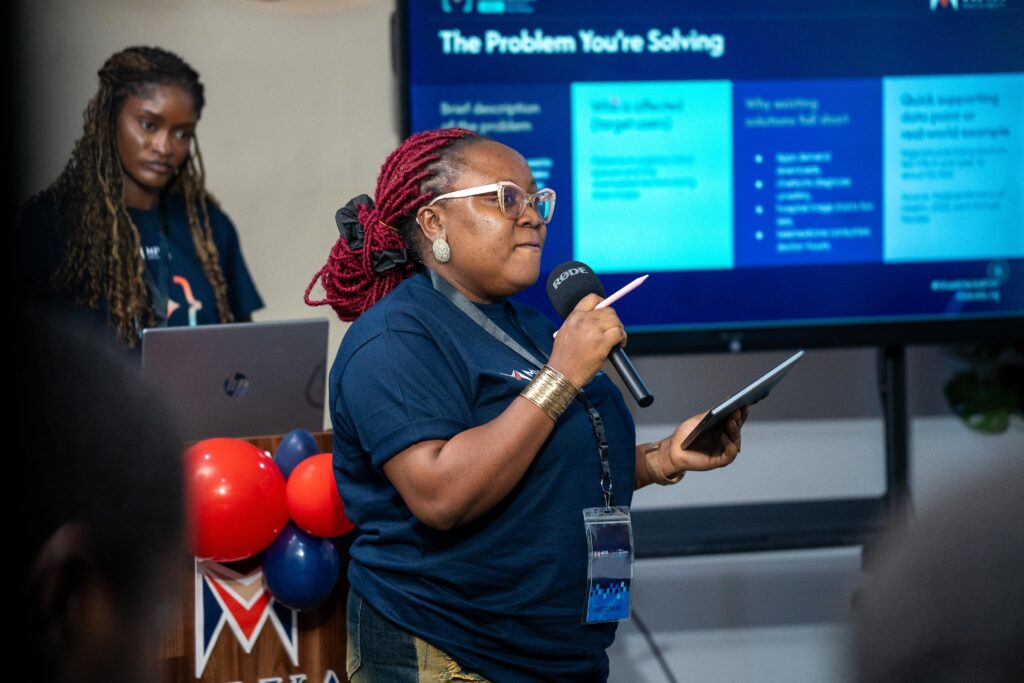
Caroline: There was never a moment when we doubted our ability. Though, when the second presenter and I were hearing other people’s presentations—we did ours last—we were like, “Ha! These people have brought a lot of solutions. Are we sure the judges will even want to hear what we have to say?” I think that was the only moment when we had cold feet. Even then, our team members kept cheering us on.
There was never a time when we doubted our ability. We were looking beyond the hackathon.
The people in [Team Vector] are looking for a way to break into the world and become tech founders. That was the motivation behind all of us there.
Nobody was unserious about the hackathon. It was a means to push us to do more. And in the group, there were a lot of hands-on people; people who were ready to work and ready to go outside of their own schedule to put the whole thing together.
So there was never a time that we doubted our ability, just the cold feet before the presentation. And our [virtual] team members kept cheering us on and telling us we were going to win. They told us not to worry because the problem we were solving was unique.
The cooperation was always there among all team members.
Your team sounds like a great team. Having people who are ready to work in a group project—it doesn’t always happen, but this is different.
Was your mentor instrumental in your project?
Caroline: Yes, but [because of the nature of the hackathon] we were extremely fast. And at some point, he would check in and then give feedback and recommendations.
We weren’t waiting for him to tell us what to do. We moved very fast, and he checked in. He communicated with the group leader and was okay with everything we were doing.
Basically, we were eager to cover a lot of miles within those 48 hours.
Yes, I understand. Some of these mentors are CEOs or directors, and they can be very busy, but it’s very important when they do take the time to check in.
The Biggest Lessons
What did you learn about yourselves as builders and as a team during the hackathon? I want to hear from both of you.
Seun: I learned about working under pressure. Even when it was an hour before the presentation, we didn’t have everything aligned.
The deck was ready, but we didn’t have the build fully ready at that time. So, I learned how to work under pressure and collaborate with people I hadn’t worked with before, while also trying to align everyone on their tasks. I’m speaking as the product manager for Team Vector.
It was actually fun.
All right. Caroline, you can go next.
Caroline: I’ll start with me. I had always known that I could perform well with a group, but I didn’t know that I could perform well with a group of tech people. Everybody knew what to do. You didn’t have to start explaining how something had to be done.
I’ve always found myself in groups where I was the only proactive person there. So I’d have to drag others to work with me to achieve our goals.
But in [Team Vector], we had a lot of proactive people. At some point, I was doubting my ability. I had to go ask in the group chat, “So where do I come in as a data scientist?” because they were already doing my work. I felt like I had to come up with something tangible to contribute to the group too.
I was kept on my toes to research more on the set topic. And when we were choosing our track, I brought ideas from my field in healthcare. I had to contribute something beneficial to the group. I didn’t want to be at the receiving end. I wanted to be part of the people who make rules or make the group move.
Then, as a group, we all worked as a unified team. That’s something that, as you said, most people don’t get.
I’ve been in different groups in the past, and I know how people come in and just relax with one or two people being active.
For [Team Vector], we had that unity, and I think any group that has it will achieve a lot.
Even when we were confused about something and didn’t know how to go about it, the group leader reached out to our mentor. Some of us went online to search, and we were able to solve that thing in less than two hours.
All right, that’s great. I want to circle back a bit. You mentioned that your mentor came in a few times, checked in and gave feedback. Were there any big changes that came as a result of this feedback?
Caroline: From what I know, concerning our presentation, he told us to go straight to our points. We were planning on presenting each page of our prototype and our backend. But he told us to go straight to our points. He said, “You’re going there to sell your market.”
Our team members on the backend also needed to go back and restructure something with the AI agent to incorporate what he changed.
Now, if you could go back to the first day of the hackathon, what would you do differently?
Seun: On the first day of the hackathon, what we’d do differently is start stronger. That would be in the sense of aligning everybody at once.
It was on the evening of the first day that we got our ideas set and started looking for a solution. We could have found a solution in three hours and started building. Still, we did a great job even though we started late.
We’d just have to get our idea early and start pushing, start production early.
Caroline, do you have a different opinion, or do you want to add something?
Caroline: I’ll add that we’d start running, like [Seun] said, start running towards the right path, and set our eyes on a bigger stage.
We were not building for just the Miva AI Hackathon. We wanted to build for the whole African continent.
Somebody had to remind us to prepare for the hackathon first. Then, after the hackathon, we can start planning for the African continent.
I’d say that next time we’re coming in, we’ll hit the ground running. We’ll go straight to building for Africa. We’ll not just build for the hackathon.
Thinking Beyond the Hackathon: From Medlink to Navira AI
That brings me to the last question. Now that you’ve won, what’s next for Medlink? You mentioned beyond Miva.
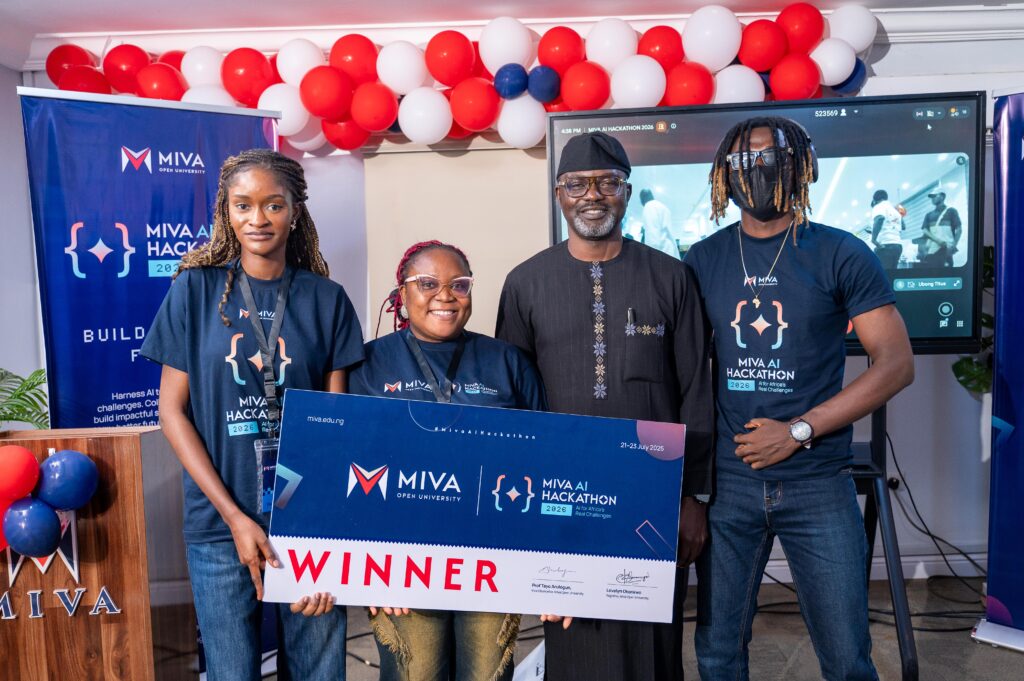
Caroline: Yes. In fact, we’ve changed the name. It’s no longer Medlink.
We are planning to remodel it, taking into consideration the corrections all the judges gave us. We’ve taken ideas from people too. So we are putting everything in shape.
And I can tell you that, as a group, we’ve even tried to go outside this hackathon and want to put in for another type of hackathon, just to bond us together as a group.
And I feel like this particular product is going to sell in the market. We are doing everything possible. The team leader is trying to see how we are going to market it. With the support we are getting from Miva as well, we are going to launch very soon.
All right. It’s great to be speaking with co-founders. What’s the new name of the product?
Seun: The new name is Navira. Navira AI.
I’m happy with how things are going. It would be even better if it doesn’t stop at the hackathon and actually has an impact.
Seun: Yes. Full speed.
You guys are doing awesome. And it was nice talking with you.
Conclusion
For Team Vector, the Miva AI Hackathon 2026 was a starting point and launchpad, not a one-time event. The experience showed them what they could achieve when people with different backgrounds came together, took responsibility, and kept each other moving under pressure.
Their decision to continue working together after the hackathon says as much about the team as the product itself. They are exploring more opportunities for Navira AI, and more importantly, they are thinking bigger than the problem they first set out to solve.
As Caroline put it, they were not only building for the Miva AI Hackathon; they wanted to build for Africa. With the product’s new name and incorporation of feedback, that bigger ambition is beginning to take shape.
The hackathon gave Team Vector a platform to build. What they do with that platform next could be even more spectacular.