
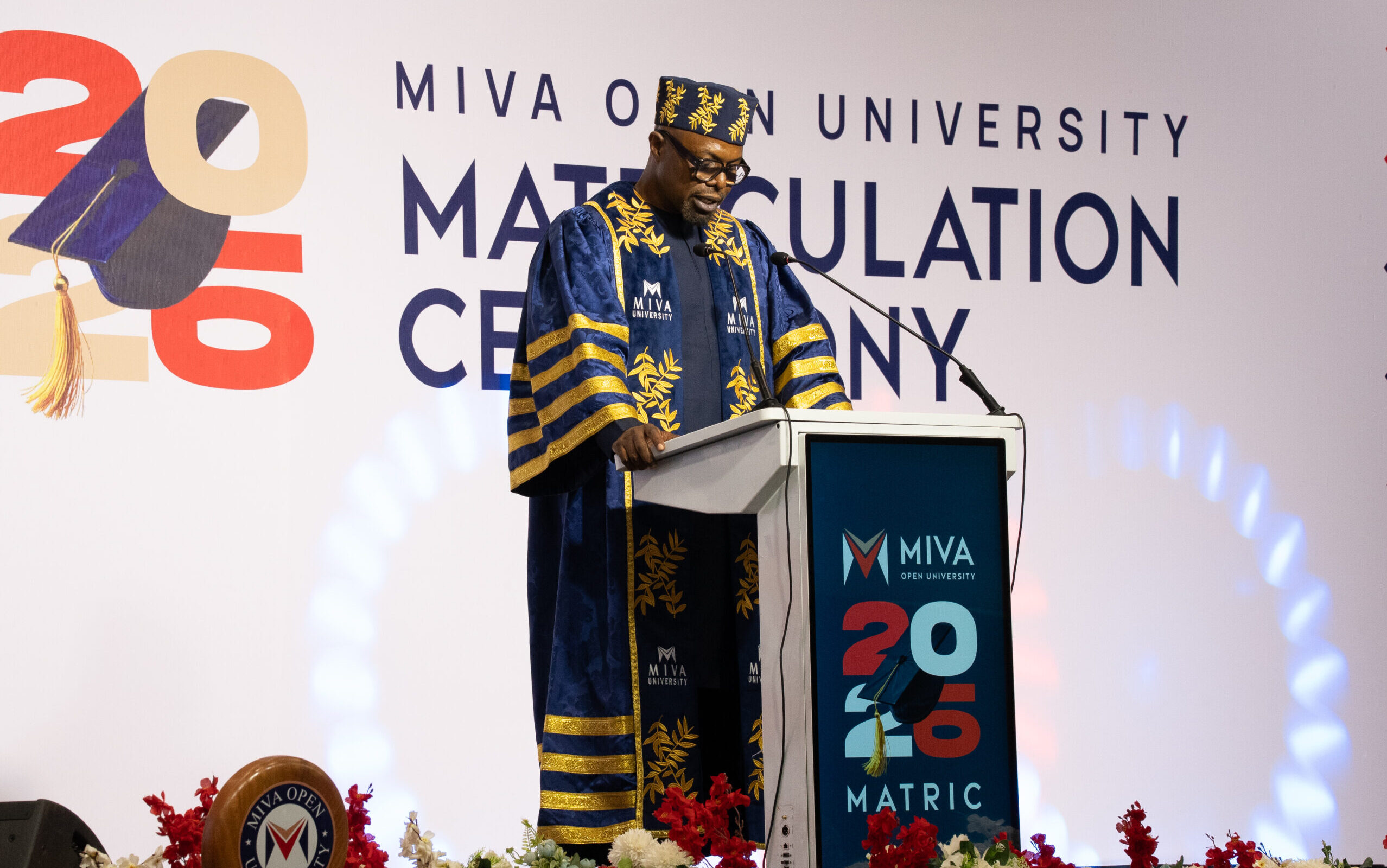
Africa’s growing population presents both opportunities and responsibilities, and education will play an important role in shaping the continent’s future. At the 2026 Miva Matriculation Ceremony, the Chancellor, Sim Shagaya, reflected on these changes, the need to rethink traditional approaches to education, and Miva’s role in making quality higher education more accessible.
He also welcomed the new students, sharing stories of people who overcame barriers to earn their degrees. He encouraged them to approach their studies with discipline, curiosity, and consistency, reminding them that their education should prepare them not only for personal success but also to contribute meaningfully to society.
In This Post
Africa’s Growth Creates New Opportunities and Responsibilities
You can never really quite get used to these views from up here at these events at Miva. One of the reasons you can’t get used to them is they just get bigger and bigger, and I can’t tell you how proud I feel to be standing here, how privileged I feel to be here in front of all of you. I feel like the luckiest man in the world right now.
It’s an incredible time to be alive, isn’t it? Yesterday I saw a car fly. How many people saw that? Behind that car flying, of course, were lots of computing and advancements in science and technology. Human beings are building thinking machines.
Machines that I hear have 90 PhDs simultaneously. It’s an incredible time to be alive. We’re harnessing energy from the sun, the way plants did for ages.
But some of the greatest changes that are happening in this world right now, you can see them right in front of you. You might not be aware that you are looking at them, but you’re a manifestation of them.
In the year 1750, over 200 years ago, there were a hundred million Africans, and there were 150 million Europeans.
By the year 1850, there were 250 million of our brothers north of the Mediterranean—250 million Europeans—and there were still a hundred million Africans. Today, there are 750 million Europeans, and there are 1.6 billion Africans.
And I’m told that by the year 2038, there will be over 2 billion Africans.
My grandfather had 40 children. He did his fair share of the work. It’s an incredible time to be alive.
Two billion is a number that’s easy to kind of roll off the tongue, but it speaks to incredible opportunity and also incredible responsibility.
It also calls for us to think about things differently. Think about how we build wealth, how we organise society, how we teach ourselves, how we learn, what it means for us to retain our culture, what parts of our culture we let go of, what parts of our culture we take forward. Miva is a composite of all of those thoughts, at least for me.
It starts with one assumption: that the way we did things cannot be the way we continue to do things. It simply will not work.
Building Miva to Break Barriers to Education
Members of the Governing Council, the Vice-Chancellor, distinguished faculty and staff, parents, guests, and above all, the matriculating class, good morning.
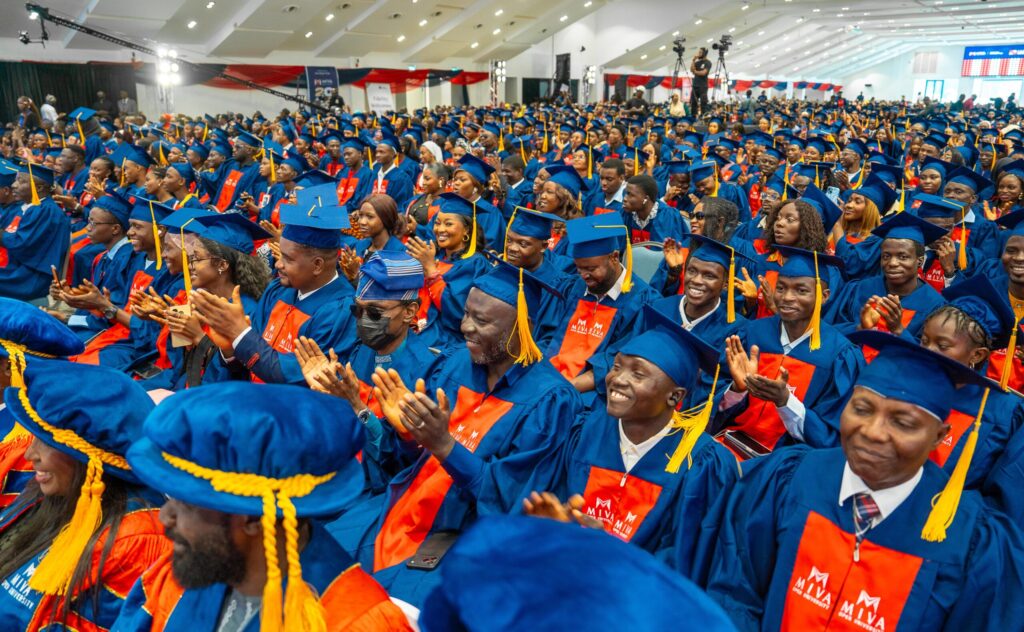
Somewhere in this hall, and somewhere in a hall somewhere in Lagos, Port Harcourt, Ogun, Oyo, or somewhere else, is a person who almost didn’t apply to Miva. They thought they were too busy; they thought they were too old, and as is often the case for human beings, maybe they even thought it was too late. But that person applied, and today you are matriculating.
This is what this ceremony means. It’s not really about paperwork, but it’s a public declaration that your future is not something that you’re going to wait for. It is something that you will build.
When we set out to build Miva, myself and my colleagues, and I’ll take a moment to acknowledge them in a little bit, we asked ourselves one question. Why should a brilliant mind be locked out of quality education by lack of access, or even worse, arguably even worse, because we insist that the way things have always been done must be the way they will always be done?
We had met too many Africans with the ability and the hunger held back by systems that had not kept pace with the changing world.
I have started over more times than I can count in my life, and I have learned that fear is overrated. It’s a mist. Fear is vapour. It is nothing. It is like a curtain, not even a curtain. The act of building, the act of action, is what defeats fear.
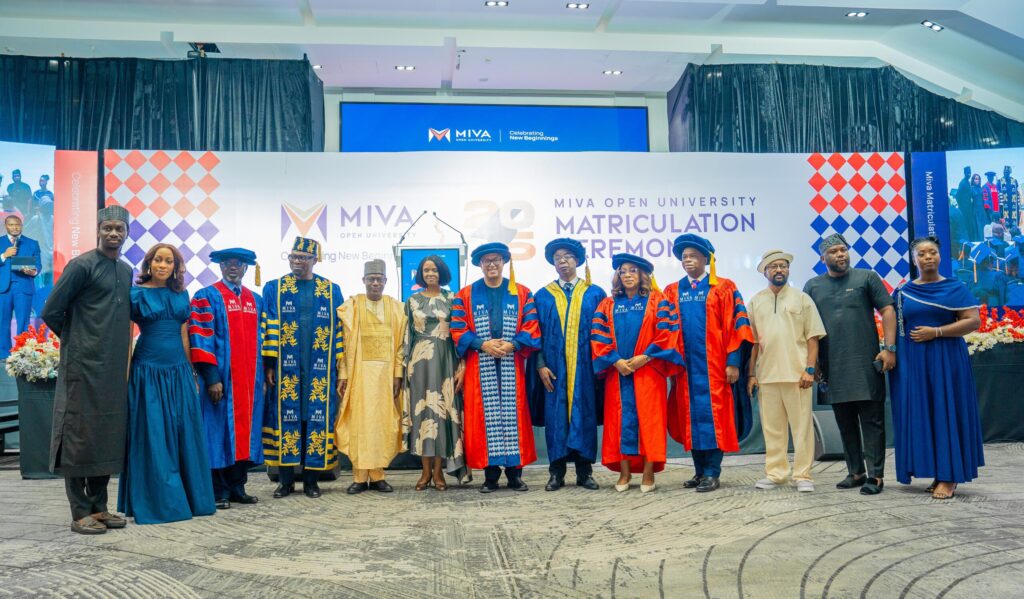
And so we built Miva to break those locks. I want to take a moment here to acknowledge my colleagues who are not part of this incredible core faculty that is building this university but sit at the group level and were there in the maternity ward when we gave birth to this baby.
Aniekeme, thank you. Just the most incredible lady. For those of you who will be studying in Abuja, seek out the privilege to meet Aniekeme, especially if you’re a woman. She represents the best of us.
Dipo, thank you. Our Head of People. Or, like I call him, our chief priest.
Udochi, thank you. Paul, I am grateful to you for a system that works flawlessly, for harnessing the power of thinking machines to make it available to the students in this room. Every time you take an exam by Miva or you’re studying and it works flawlessly, primarily give credit to Paul.
AyoOluwa, for working with me for eight years. And last, and of course not least, Iheanyi Akwitti, who has become more of a brother to me than a brother. I am in my last quarter as the CEO of the uLesson Group, and then I move to the rather important-sounding title of chairman and hand over to Iheanyi.
It almost seems like I hand over to you with an apology because I know the burden that you’re going to carry. Well done, Iheanyi, and thank you.
So let me come back to the students.
It Is Never Too Late to Learn
During the convocation we held in Lagos—and it probably had more of an impact than I anticipated—I called out a lady called Winifred Agboola. Her name became very popular in Nigeria for a few days. I spoke about her during that convocation because for seven years Winifred fought to complete her education at a state university.
She put in seven years of effort and sacrifice and hope, and she could never quite get there. And when life spoke louder than her plans, as they often do—we have children, we have babies, illness happens, misfortune happens—she gave up on her plans and stepped back, went home and gave 10 years to raising children, as many women do across the continent.
She focused on being a wife [and] a mother, but she never forgot her dream. And so when Winifred found Miva, she did not find a shortcut; she found a door that finally let her in, and three and a half years later she balanced all of those responsibilities.
Not that she shed those responsibilities—she still carried them—but she realised the dream of that degree, enriched her mind, and moved forward. I’m telling her story because whether you are joining us right after secondary school or restarting a journey, thinking at one point that it was too late, you share the same spirit as Winifred.
Some of you came straight from a classroom—secondary school—and some of you came while balancing jobs and businesses and family. Some of you are wealthy; some of you, not so much. At the risk of personalising too much and maybe embarrassing them, this was not part of the speech. I literally, I promise you, just thought of this right now. My chef and my househelp, who are more like family to me than staff, are matriculating today.
Miva was built for Valentine and Alex. Miva was built for all of you. You did not choose the easy route; you chose the ambitious one, and behind many of you stands a parent, a partner, a family member who made room for this dream.
And so to the families that are here today, thank you. Your belief is every part of the results that we will celebrate when these people graduate. You are joining Miva, like I said, at a remarkable moment.
Since 2023, more than 40,000 students have enrolled. Our first graduates have taken their degrees into workplaces across Nigeria. Miva is no longer a pilot; it is a university.
And it is a university with the same gravitas and weight and implications as Cambridge or Oxford or Harvard or Stanford or Princeton or Yale. I claim it, and so it will be.
Now I’m not going to pretend that this road is going to be easy.
Somewhere around the fifth or at most the sixth week of your first semester—because we look at the data and we see the statistics—the excitement of today will fade, and then you will wonder, What the hell am I doing?
The work will be demanding, the house will be loud, your younger brother will be making noise, the internet will fail at exactly the wrong moment, and when it doesn’t fail, Instagram will be calling you. Am I right? And you will wonder what you’ve signed up for.
Every one of our graduates has had that night, and what carried them through was not talent; it was a promise. Ours to them, and theirs to themselves.
Miva Owes Students Rigour, Support, and a Path to Meaningful Work
So here is what we owe you. Let me tell you what Miva owes you.
We owe you rigour. Your degree must carry weight in an interview room, in a boardroom, and in a country you choose to work in, whether that is Nigeria or elsewhere.
We’re not going to make it easy, but we also owe you support. Lecturers who know your name, learning centres within reach, and MIND, our AI learning companion, for when the questions come at midnight, and they will.
And we owe you a path to work, to productivity, and to a meaningful life. That is why executives-in-residence will teach you in your classes and why our master classes will put you in rooms with people who have done the work and not only studied it.
To our faculty and staff who keep these promises day after day, thank you very much. Do not let go of the standards. Balance kindness and empathy with rigour. These brilliant minds that are here today did not come here to coast; they came here to be better, and better is forged through difficulty.
Discipline and Consistency Over Talent Alone
So, dear students, here is what I want to ask of you. I’ve told you what we offer you; now I want to tell you what we ask of you. Before I do that, let me tell a story.
About 23 years ago, I completed my own MBA. I walked across the stage, and I got my degree. As soon as the ceremony was over, I walked up to my parents, and as is traditional in African society, I went to my father first, and I handed him the degree.
Now you have to understand, my father was in the military, and even in the military, which is very disciplined and very regimented, he was an especially regimented person. So that is the context for the story I’m telling you. And I went to him with this degree, and it was from Harvard, a Harvard MBA, and I handed it to him, so proud of myself.
Thank you for the applause, but if you know my father, he didn’t applaud. He took the degree from me, unwrapped it, looked at it very carefully, and then he said to me—I’ll never forget—he said, “This is a nice pair of canvas.” He comes from that generation of Nigerians that don’t say sneakers; they say canvas.
He said, “This is a nice pair of canvas, but let me tell you something. If you do not work hard, if you are not disciplined, if you do not push yourself, the man who is barefoot will pass you on the road.”
He delivered that message right there, in that moment, when I expected applause. And that is the message I am passing to you, except you have the advantage now, before graduation, of hearing that message.
It doesn’t matter how gifted you are; it doesn’t matter how smart or good-looking or talented [you are]; it comes down to discipline, consistency, small hours, a million small steps, day by day by day, compounding into something big, something powerful. A little bit of heroic effort every day, a willingness to ask why, be curious, and dive deeper when other people have stopped asking.
Do not just absorb the lectures; argue with them; and test every idea against the world you already know. Question everything.
We are a university, like I said, of rigour, of discipline, and of respect, but we are not a university of dogma. We are not an institution that says you cannot ask questions and challenge and interrogate ideas.
Use the tools we give you to go deeper, not just to finish faster. Be generous. Someone in your cohort will be struggling quietly; read their faces even when they are too shy to ask for help and offer help.
Be the person who keeps them going and be proud of what you’re doing. And when somebody asks you whether an online degree is real, answer it not with your words but with your work.
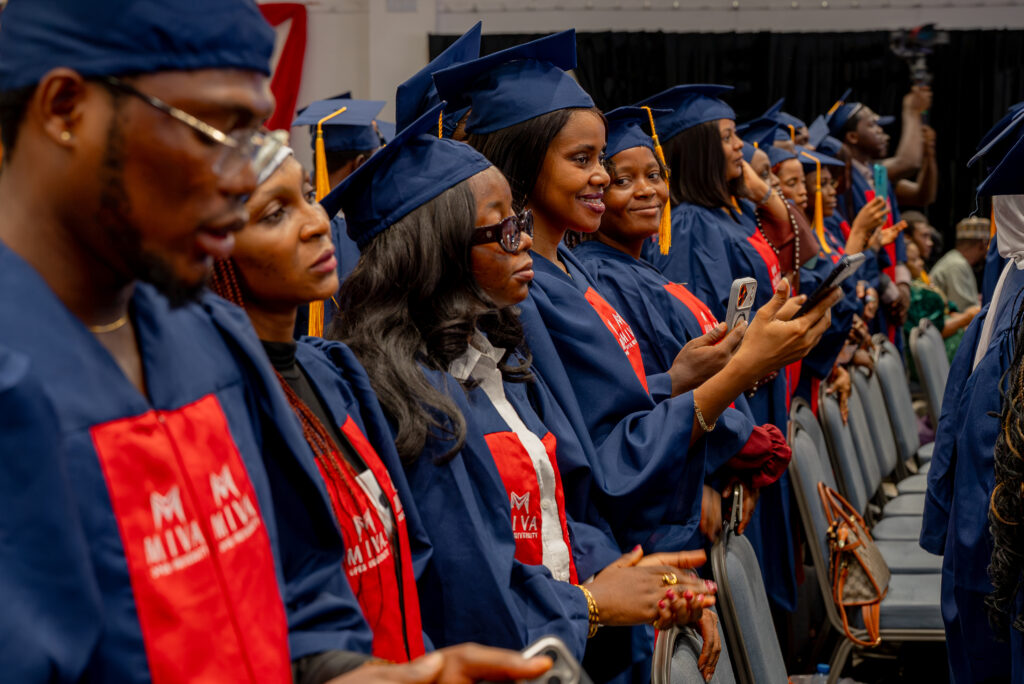
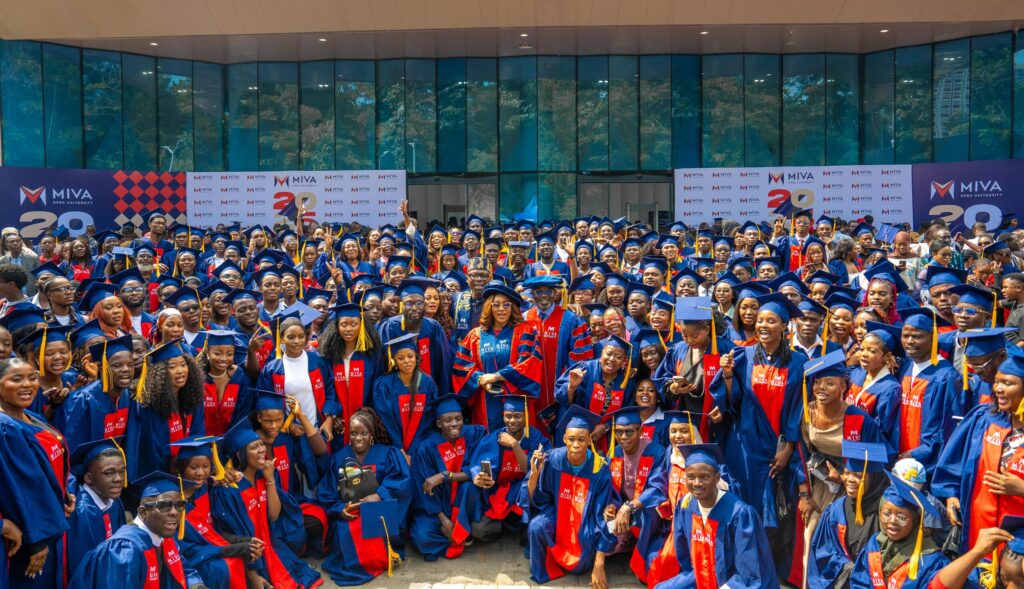
A cross-section of the 2026 matriculating class in Abuja.
Miva Is Growing Without Compromising Quality
We are building towards something far greater: a Miva study centre in every local government across this nation, state-of-the-art robotics and drone labs, a world-class research institution.
Our ambition is to impact 1 million Africans over the next decade, and it’s not just a slogan; it’s a commitment, and it is sitting right here. 500 to 4,000 to 8,000 to 40,000. We are marching; we are on the journey; we’ve passed kilometre 40,000.
Pretty soon we’ll be at 1 million, and we’ll be at 1 million without ever compromising quality and rigour. Three, four, or five years from now, you will stand here where Winifred and others stood, and the only difference between today and that day is a million little steps, discipline, consistency, [and] hard work. Those are the steps. That’s the difference between here and that point when you graduate.
Africa will not be built by spectators. It’s a new continent that’s emerging. Sometimes we are anxious, and when we argue on social media with ourselves, when we criticise our leaders, really it’s just a manifestation, I think, of anxiety about the future.
What does this all mean?
We have cities and towns that did not exist 50 years ago. 20 years from now, you will likely drive from here to Jos, and you will probably go maybe five minutes at most without seeing a human being. Lagos will be joined to Ibadan. It will be one continuous metropolis.
We will need new systems for organising ourselves, for getting water to people, getting electricity to people, for defending ourselves from people who don’t mean us well, new methods of thinking about economics, new definitions of capitalism. It’s a huge challenge, and we have to do this all without leaving anybody behind who is handicapped, not through any fault of their own.
It’s a major challenge, and what will make me glad 20 years from now is to see the people in this room have played a major role in making that happen. We are here to break locks. That is what we’re here to do.
So today, you walk through. Now go and build what is on the other side. Go and build yourselves.
Welcome to Miva. It’s not going to be easy, but you’re going to be such a better person on the other side because of it. Thank you very much.
In Summary
The Chancellor concluded by challenging the matriculating students to become active participants in Africa’s development. He urged them to use their education to solve problems, create opportunities, and help build a future that leaves no one behind.
He reminded them that achieving these goals would require more than talent or a degree. Through consistent effort, hard work, and a willingness to keep learning, he encouraged the students to make the most of their time at Miva and build what lies ahead.