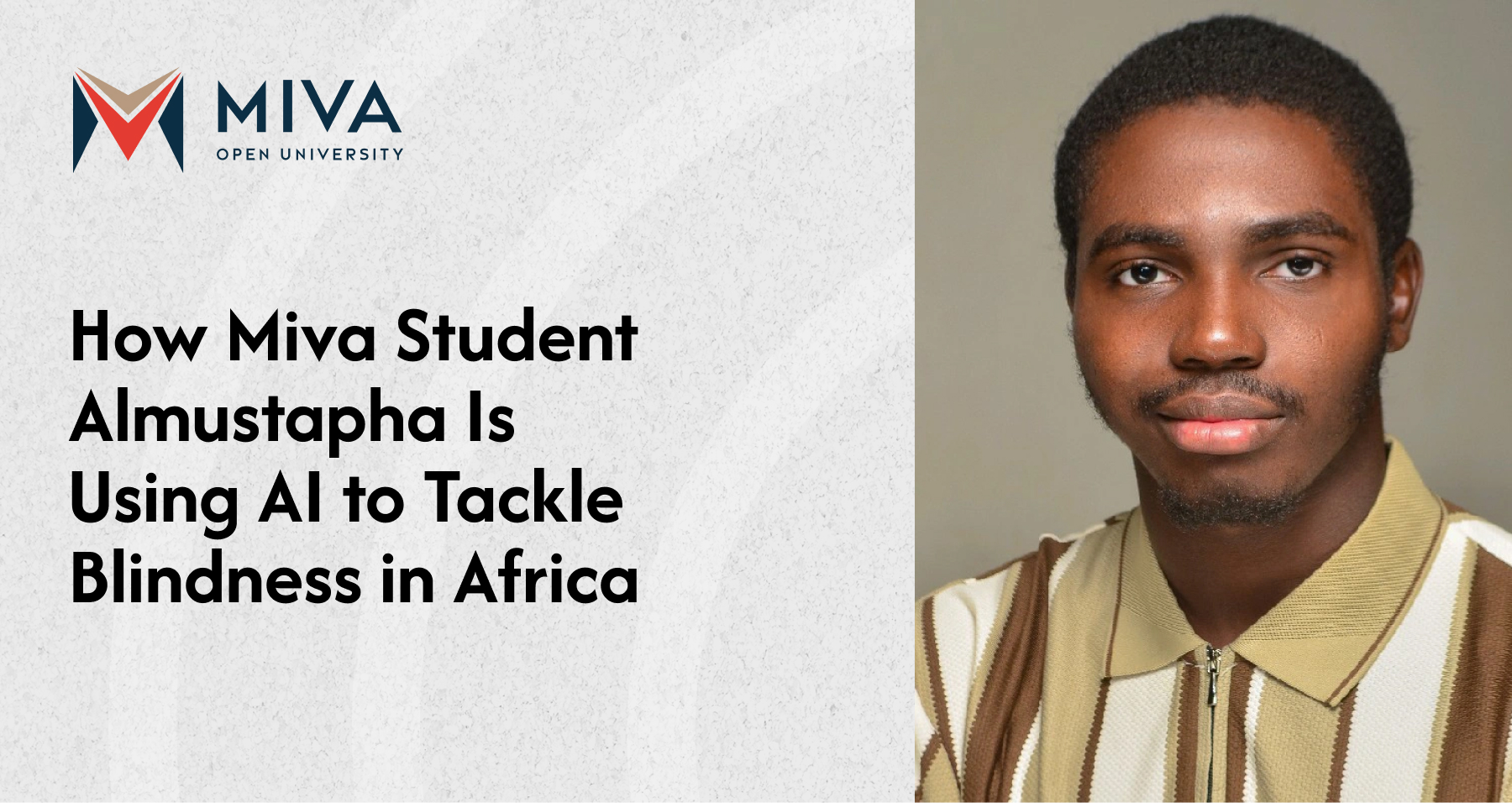
As a Miva Data Science student from Kano, Almustapha Damilola Usman has pursued opportunities to learn, build, and solve real-world problems, from internships and AI projects to founding ZisoCare, a health-tech startup focused on tackling preventable blindness in Africa.
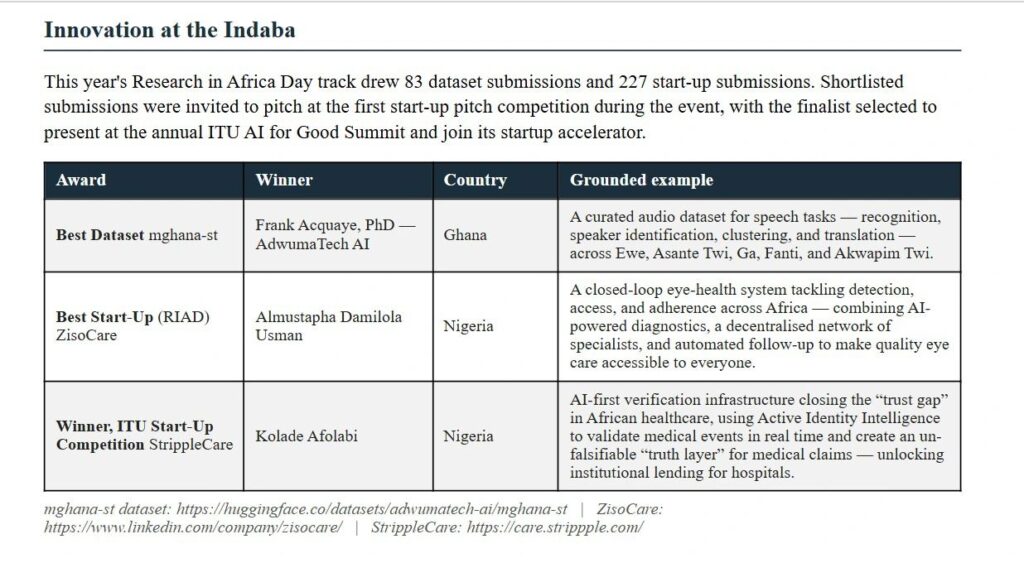
After a series of pitches, setbacks and accelerator programmes, ZisoCare was recognised as the Best African Startup at Deep Learning Indaba 2026. Deep dive into our conversation with him.
In This Post
From Civil Engineering to Data Science
Tell us about yourself and what inspired you to study Data Science at Miva.
My name is Almustapha Damilola Usman. I currently live in Kano. I was studying civil engineering at a traditional university. I was in Year 3, going to Year 4, before I dropped out to focus on Miva and Sterling Bank’s internship.
I’ve been the kind of person who finds it more comfortable to learn from a screen than in the classroom. I enjoy learning in the classroom as well, but I tend to push myself forward and enjoy self-taught learning and engaging with other people out there.
During the COVID-19 period, I was part of the people who benefited from uLesson. That was where my journey started. I love Sim very much; the way he thinks and how he does things has always been how I envisioned myself to be. I love anything that has to do with technology.
But given the kind of conditions I found myself in while growing up, losing my dad at the age of 10, and having to sponsor everything myself with my mom, I decided to follow the normal Nigerian way of choosing a particular course, going to school, and after school, finding a job to do. But it wasn’t really my own passion. I joined engineering because I wanted to do something hard.
But when I was in 200 level, I heard about Miva. I felt Miva was kind of like the senior brother to uLesson. And when I was part of uLesson, I enjoyed my time.
That’s where I was able to expand my knowledge and build a foundation in STEM education. I always hoped to join Miva. In 2024, I applied to Miva. I got admitted, but I couldn’t start because of money. I had applied for Software Engineering then.
Last year, I got to know about Sterling Bank’s Beyond Education Scholarship Programme and saw that Miva was one of the schools one could get admission into by joining the scholarship.
So I pursued the scholarship with all my might. And luckily for me, I was among the top 15 in my cohort for the Beyond Education Scholarship. That was how I got into Miva.
So why did I actually choose Data Science? For over a year now, I’ve been into AI and machine learning. I knew about AI even before ChatGPT launched; I’d been following the innovation way before IBM Watson was created. I’ve been learning about AI and machine learning for a while now.
I started learning about its concept and how it works with ALX and others. That has always been what I want to go after. But there was no degree course for AI and machine learning [then] in Nigeria. The schools that offered the course were very expensive. I couldn’t afford them.
When I got the scholarship with Miva, I checked around and asked, “What can I actually go for that is in line with what I’m doing?” I was already learning data science with some edtech platforms, and it was in line with AI and machine learning. Without data, AI is not going to function the way it’s supposed to function.
Let’s forget the algorithm. Data really matters. I love data. I’ve been interpreting data to find meaningful insights and tell stories. That was actually why I applied for Data Science at Miva Open University.
It was in line with what I had a passion for. And to be honest, I don’t regret it for once: giving up my other school so that I could focus on Miva and the internship with Sterling Bank. It has been a wonderful experience since last year.
ZisoCare: From Internship Project to Startup
Honestly, it was never part of my dream to do anything ‘entrepreneurial’. I always had the intention that I was going to contribute to companies through data science, AI and machine learning, building models, carrying out analysis and working on innovations. I never dreamed that on my own, I would start up something like this.
It all started last year when I was doing an internship in Abuja with FlexiSAF. It was a data science and AI internship for five months. When we completed the internship, they grouped us together to work on a project, specifically health projects. Before then, I’d already worked on two health projects with the edtech platform I had studied with.
After we were grouped, we deliberated on what we would work on. Somebody said malaria, but I didn’t want us to work on something that someone else had already worked on before. I really wanted it to be distinct. Something that could be implemented in the real world; not a project that we’d do with this edtech platform, and then the next thing, we just dump it, and it’s of no use. Or perhaps replicate what is already available on YouTube. I don’t like doing that.
I like working on things that can be implemented in the real world. Someone suggested diabetes. I objected because I had already worked on diabetes. Then I did some research, and then I heard about diabetic retinopathy.
I discovered that diabetes could lead to blindness. I never knew about that before. That was the first time I came across that.
I relayed that to the team and asked if we could focus on diabetic retinopathy. But instead of building a classification model, as most people do, we would be building a prognostic model. That is, combining classification models together with a model that can track what happens to the person over a long period of time.
Everybody agreed, and then we started working on it. It wasn’t easy at first.
The data was on Kaggle. I’m currently a verified data scientist on Kaggle. We got the datasets from Kaggle for retina imaging. I handled the AI and ML parts. I was the only one on the team who could do that. It was difficult to get clinical datasets, which is crucial.
We knew we couldn’t get that. But to achieve what we were going to achieve, we had to do a lot of research and consult with doctors. We asked them about the clinical features that a person exhibits when a person has diabetes that could lead to diabetic retinopathy. I got this information, and I prepared the synthetic dataset.
I created the synthetic dataset and fused it with a classification model (one classifies the image, and one collects the clinical datasets).
I fused them together for better accuracy. We spent almost a month building it due to a lack of resources. It wasn’t perfect. The accuracy was around 74%. I was able to take it to 75% accuracy.
But I knew it couldn’t be deployed into the real world. But that kind of architecture doesn’t exist out there in the world. And it is going to be much more efficient.
When we finished the internship, we published the project. I told my team members that I didn’t want this to end at the internship. I asked them if we could turn it into a project that turns into something bigger. They were concerned about where we would get a designer, resources, and medical practitioners.
I believed we could achieve this. Many people stepped down from the project. Only three of us decided to move on with it. That was during my exams last year, in December.
Pitches, Accelerators, Rejections, and Recognitions
Luckily, ALX started the ALX Founder Academy, a bootcamp for early-stage founders. I joined, and there, I learned about what it takes to be a startup. I was combining the bootcamp activities with my Miva exams, and it was hectic.
Based on the experience I had during that five-week period, in early January, we applied for the National MedTech Foundation – Ignite Startup Accelerator that focused mainly on people who want to innovate in health. We joined this virtually, and it was a programme for 15 weeks.
During that period, I also applied for Hult Prize Nigeria, where students compete for a million dollars.
This is what I want to do. This is what our research is telling us. The problem was huge. We were pitching online and physically, competing in Kano.
With the Ignite Startup Accelerator, we were able to talk to a lot of professors and industry leaders, and they shifted our attention to focus on what can work in Africa at the moment instead of trying to build everything at once. How would the users use the diagnostic model that we wanted to build? How would we deploy it? What was the major problem? Those were the key questions we had to answer, among others.
So we decided to go back to the drawing board and do more research. We discovered that the major problem was not only access to specialists. There was also the problem of patients not knowing that they had a disease that could make them blind. Then, we have a shortage of ophthalmologists and optometrists in Nigeria as a whole.
We decided to start with access. We got 25 Lovable credits from Hult Prize Nigeria. We just did a design. At that time, a friend of mine had just finished her final-year exams in BUK as a doctor of optometry, so I brought her in because it was her field. We found out that what we thought was the problem we were solving was not the main problem.
She acknowledged that the diagnostic model we had built was great but questioned how it was going to be used. That was the main question.
During our conversations with the Cambridge professors, we discovered that we were trying to do multiple things at the same time. We needed to focus on one thing and build upon it.
By the time we finished the National MedTech Foundation – Ignite Startup Accelerator, that was the same time we were pitching in Lagos at Hult Prize Nigeria among the top 25 in the whole of Nigeria. We made it to the top eight but couldn’t proceed.
Immediately after the programme, we got selected for the iDice Startup Bridge Founders Lab Programme, where we got to know more about what it means to be a startup in Nigeria.
At some point I actually wanted to give up because the stress was a lot, trying to combine my academics with making sure that I do the right thing as a founder. I also had to ensure that I was executing my obligations at Sterling Bank as an intern. Combining these three things together was very hectic.
The Road to Deep Learning Indaba
It was during the National MedTech Foundation – Ignite Startup Accelerator that we applied for the Indaba startup showcase. When we applied for it, we only had a project proposal of how the AI systems were supposed to work.
I registered for Deep Learning Indaba as a startup for ZisoCare and also as an individual who wanted to attend. I had heard about Indaba for about 2 years now. I had seen the energy in AI, ML, and data science. The community was wonderful, and I wanted to experience it myself.
I didn’t get the opportunity as an individual, but the startup got the opportunity. I was very shocked when we were announced as the winner during the closing ceremony.
My reason for going to Indaba was to put what we were doing out there. I didn’t just go as a person who wanted to learn; I went there to put out ZisoCare. I got to pitch to a lot of people in the industry; we sat in rooms with AI and ML decision-makers of Africa, and I got to learn a lot.
I questioned whether I could keep moving forward with the people that I met and the feedback I got from them. It was a lot and, at the same time, interesting.
It’s not easy being a student in Nigeria and trying to work on a startup. There are people who want you to just focus on school because you’re a student, or think that because you’re young, you still have a lot of time to work on things.
Regardless, I spoke to a lot of sponsors and venture capitalists, and their questions were more like interview questions to help us learn.
With all the effort I put into it and the representation, when we were announced as the winner, honestly, I was shocked.
Miva’s Role In the Win
It wouldn’t have been possible for me to go to Indaba if Miva wasn’t flexible. I went to Indaba when we started our exams. I had to defer my exams to go. If Miva hadn’t made it possible for students to defer their exams and write them later, I wouldn’t have been able to make it. I would have wanted to ensure I wrote my exams and not fail because I’m on a scholarship and we have requirements to meet.
The flexibility that Miva gave me is one of the reasons that I’m able to focus on the startup, deliver on my obligations at Sterling Bank, and at the same time try my best to catch up with my education. I’m already used to the system, starting from uLesson and learning alone.
With the 18 months of experience I had in data science, where I had learned a lot and gotten certifications as a beginner as well as being a student with access to Microsoft’s and Google’s learning platforms, it was much easier for me to study Data Science at Miva.
The curriculum is top-notch, not like conventional universities. Miva gave me the right background and opportunities to build ZisoCare. I usually say that Sim Shagaya built Miva for people like me. A conventional university doesn’t give us that flexibility.
I was at a traditional university for three years. I know how stressful it is doing my personal business along with my education. It was very difficult, to the point that I lost a lot of customers when I was selling laptops and had to stop other endeavours just to concentrate on school.
If you ask me one of the best things that happened to me between the end of last year and this year, it would be Miva. I wouldn’t have been able to achieve what I have achieved so far if that flexibility wasn’t there.
Your story…it shows resilience. Despite the ups and downs, you kept pushing forward. It is inspiring.
Thinking Differently and Doing More
During your internship, you were asked to work on health, but you did not want to do it the conventional way. Why diabetes, though?
As I said, they suggested things like malaria and maternal health. I mentioned that we needed to look at the available datasets on Kaggle. There are many datasets on malaria, but many people have worked on that. I had worked on diabetes too during my first training as a data scientist.
These are all things that people have worked on, and I never wanted to work on something someone else has worked on. I wanted something different.
Something distinct that was going to stand out. That was why we went for diabetic retinopathy, not just diabetes.
That’s clearer. I’m wondering though: you are in Miva, you’re doing an internship with Sterling Bank, and you did another internship in Abuja. Why are you doing a lot?
Yeah. That’s a good question. Before I got the scholarship at Miva, I was trying my best to increase my technological knowledge, especially in data science and how AI can be implemented in real life. Reading alone is not sufficient; I need to learn and work on projects. I’d already been doing that before I got the scholarship.
Recently I stopped most of that and tried to shift my attention to just the school, my internship, and the startup. The internship with Sterling Bank is a requirement attached to the scholarship, and it’s just three times a week.
Among other activities going on, those are the three things I give most of my attention to because they are the ones that matter.
Since I’ve been doing all these things before now, many people know me for it. Sometimes I’ll be called to give a speech or be at a programme online or in Kano, and I have to opt in, because that is one of my major goals: to empower people with knowledge—technological knowledge—and give them the right resources that they should have access to, which I personally didn’t have access to when I started out.
Why ZisoCare Stood Out at Indaba
What do you think made your project stand out, among the other innovations at Indaba?
From the feedback I got, it was because we weren’t trying to do every single thing. Secondly, we understood the problem. What we’re working on has to do with the main stakeholders—the hospitals, the eye specialist hospitals, the optometrists, and the ophthalmologists. But at the same time, we can’t leave the patients out of it because they are the ones suffering the most. They are the ones going blind.
What made it stand out is that we did not just focus on ‘eye’ healthcare; we focused on that but also tried to touch the main pain point. Whether it is the patient or eye specialist hospitals, we are trying to understand how to solve their problem. That was one of the pieces of feedback that we got.
We can’t work on everything at the same time. You have to focus on just one thing, and then when you’re grounded in that, you move forward. That is the approach we are currently taking.
That has always been what makes us different from other people, not only at Indaba. Even in other accelerator programmes that we have joined, like the National MedTech Foundation – Ignite Startup Accelerator, that was what separated us from other people. Why eyes?
All right. Being specific, and you mentioned that you were trying to do a lot, but having professionals onboard helped you to focus on a problem. You can iterate later and build upon what you’re already doing.
Faith, Resilience and the Will to Keep Going
What has this recognition taught you about your potential as a young African innovator?
What this recognition has taught me is not to give up and to believe in myself. Something happened before Indaba. I had pitched ZisoCare three days before I left Kano for Lagos. I pitched at the university at Wema Hackaholics 7.0.
Yes, we did well, even though we had a lot of feedback and corrections, but we were not among the winners. At that time, it kind of affected me because we did every single thing, including the roadmap, but we hadn’t launched. We hadn’t had the major users that we needed to have.
If I had taken that mentality to Indaba, it would have affected me badly. If I had stopped, if I had given up earlier this year, after the Hult Prize, where the competition was tough, or after other rejected applications, if I had defined myself by the failure and rejection that we encountered, I’m not sure I would be able to be at this interview.
That was one thing I learnt: to be resilient, to keep moving forward, and to put what you are doing out there.
It doesn’t really matter how small it is; people are watching. We realised that a lot of people were watching. We haven’t gotten to where we want to get to. We haven’t got all the people who are going to guide us to achieve what we want to achieve. But many people know about ZisoCare more than they know about me.
So I kind of feel that we should just keep building, regardless. The African condition is not favourable. So I learned the mindset of what it means to actually be a founder, what it means to be resilient, and what it means to keep pushing forward regardless of the kind of setback that you have. It pays off eventually. It may not be immediately, but you’ll eventually get there.
Yeah. Resilience is a key factor for entrepreneurs. Not everybody can be an entrepreneur, but if you believe there’s a problem and it needs to be solved, you just have to keep at it. If you fail, the problem continues. And so that’s very important.
The People Building ZisoCare
I want to know more about your team.
I’ll mention the four teams and some lapses we have on the team as well. I’m the CEO.
Omasirichukwu Oji, the team lead during the internship, is a co-founder and is in charge of operations. She’s a graduate of Forensic and Analytical Science from Robert Gordon University, Aberdeen.
The Doctor of Optometry on the team and co-founder is Basirah Adejoke Musa, a graduate of Bayero University Kano. She’s the Chief Medical Officer. She’s also into data analytics and is involved in outreaches with NGOs and other bodies that screen people in underserved communities.
Then we have Ose Damien, a graduate of Electrical and Electronic Engineering from Ambrose Alli University. He’s a brand strategist who came with us from the internship.
On the content team, we have Zainab Abdulmajeed. She handles our social media and community management.
We have two people who have played a crucial role for us. There’s Dr Wale Ogundeji, a medical doctor and AI and ML practitioner who’s more of an advisor to us. He’s been an advisor right from day one.
We also have Mrs Oluwatimilehin Aloro-Olabamiyo. She’s not a medical practitioner, but she handles EPR and the rest. She’s with National Health Service Borders in the UK and has been guiding us when we need assistance. She represented us physically at Cambridge.
These are the core people who have been working on this project. We have other people who are part of the team.
For lapses, we currently don’t have a CTO. I’ve been the one handling the technical aspect of things, like the MVP building. We’re trying to find someone who can fill that particular space.
What’s Next for ZisoCare
So what’s next for you and ZisoCare, and what impact do you hope to make with it?
We have secured a $4,000 grant from iDice, and we want to use that money to deploy ZisoCare through community outreach. Our main aim for this is to build our diagnostic model using African datasets, not general datasets.
The datasets we need are not readily available, so we need to start collecting these datasets. That is going to mean partnering with NGOs and bringing a lot of medical people on board who are going to conduct the outreach.
This automatically generates impact because we are creating awareness and at the same time saving lives by making sure people don’t go blind. That is the impact that we are trying to work on. That is the easiest impact we can have in the meantime.
When it comes to the general impact, employment comes first. When ZisoCare begins to produce results, it’ll have a positive impact on the many optometrists and ophthalmologists who aren’t functional.
We know the problem that is happening in the healthcare sector—the stress doctors go through, being underserved, and qualified medical personnel choosing a different career path to make money. If we can bridge that gap by creating more employment for them, it is a win-win for ZisoCare, the eye specialists, and the economy.
By reducing the rate of blindness in the country and in Africa as a whole, we are also increasing our employment opportunities.
We are trying to increase the revenue of the eye specialist hospitals through retention and make the patients feel seen and heard.
When it comes to what is next for us, we want to ensure that our MVP is ready – something usable, functional, and tested.
Anything that we are working on has to be medically aligned. That’s the main thing we are trying to achieve. We are not positioning ourselves as a technological company, building technological tools that are going to be used in hospitals.
We are trying to build technology around the people that are actually using it. So the platform is tailored to the optometrists, ophthalmologists, and eye specialist hospitals and the workflow that they use.
We are not building a general technology platform or digitising hospitals like others are doing. It’ll become part of what we do in the long run. But the core thing is that what we are doing is medically aligned.
Secondly, we need to have a lot of pilot partnerships with these eye specialist hospitals and clinics, though it has not been easy to penetrate them. We have had two to three presentations here in Kano, but the hospitals are more focused on retention and revenue.
Getting people who will give us the access that we want hasn’t been easy. It’s not been easy having to go through bureaucratic procedures, especially as a student. That is one of the reasons why we want to bring Miva into this to support its own students.
If we can get somebody like Dr Kunle Hassan, who is the founder of Eye Foundation Hospital and one of the major leaders when it comes to eye health in the whole of Africa, having that kind of person to back us is going to open doors for us to integrate into these eye specialist hospitals that have little to no digital technological integration.
So if we handle that particular aspect, it’s going to be much easier for us to scale and move forward. And when we have that type of endorsement, I don’t think anything is going to stop us either. That’s the next step.
That’s great. You might want to talk with the Career Advancement Centre at Miva. You should also talk with the lecturers in Public Health and Nursing in the School of Allied Health Sciences.
You can start from there so that you can leverage the opportunities Miva has. If you are doing something impactful, Miva will really support and put you out there.
Conclusion
For Almustapha, winning at Deep Learning Indaba is not the end goal. With a $4,000 grant secured, he and his team are focused on testing ZisoCare, collecting African datasets and building partnerships with eye-care providers.
His journey so far is a reminder that meaningful innovation often starts with asking different questions, staying resilient through setbacks and continuing to build.
With Miva Open University giving him the flexibility to pursue his education alongside his work and startup, Almustapha is focused on taking ZisoCare from an idea to a solution that can make a real difference in eye health across Africa.