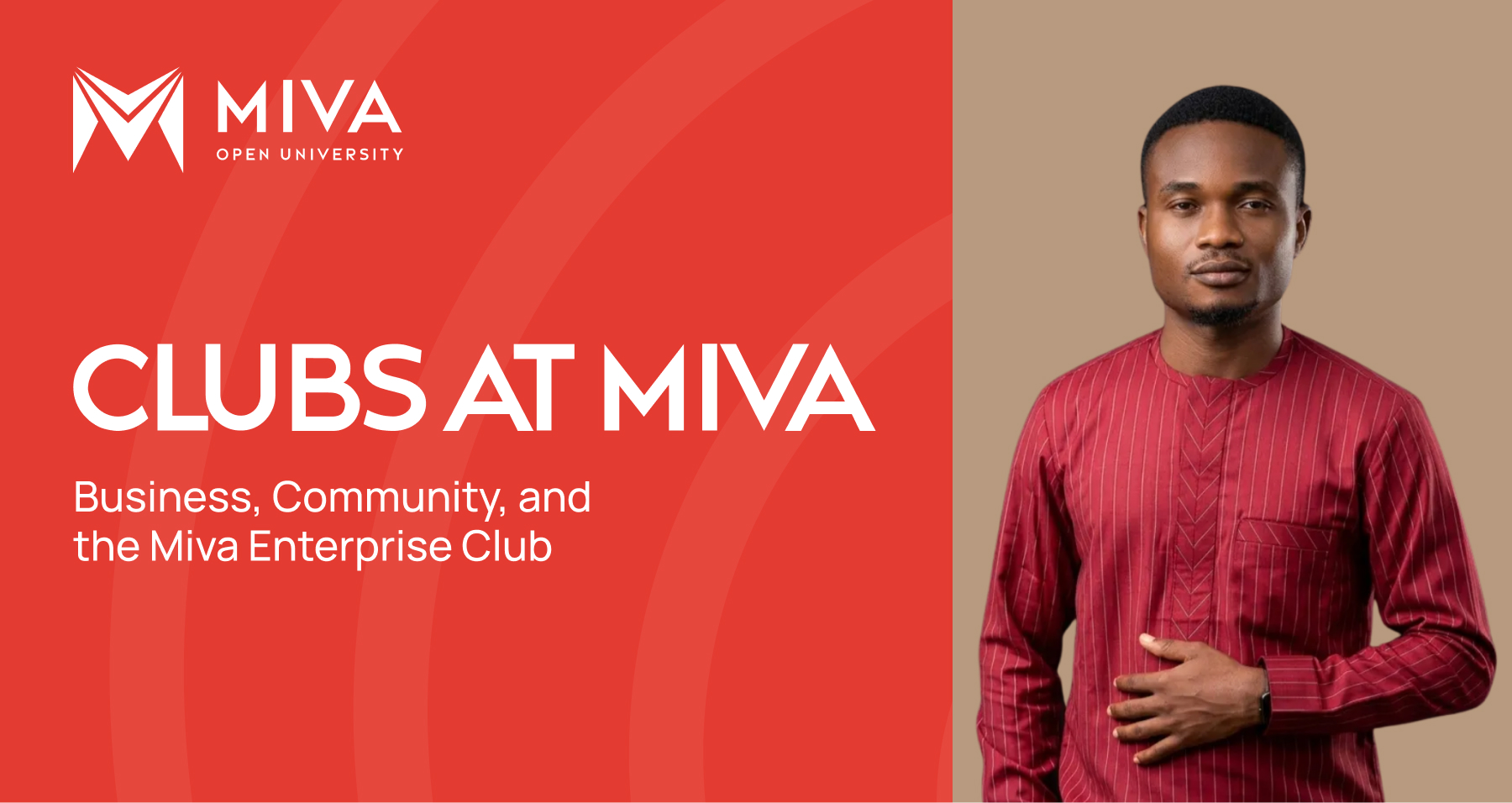
What happens when a student brings an entrepreneurial mindset to university? For David Obi, it means building businesses, finding community and helping other students turn ideas into action.
As the outgoing president of the Miva Enterprise Club, David shares what the club is about, what he’s learnt, and why student entrepreneurs don’t have to build alone.
In This Post
Meet David and the Miva Enterprise Club
Please introduce yourself, the Miva Enterprise Club, and your role in the club.
I’m David Obi, currently studying Mass Communication and Media Studies at Miva Open University. I’m also the current President of the Miva Enterprise Club.
The club is all about helping students understand how they can grow in their entrepreneurship journey.
It’s also a community to network, meet like-minded people, and work on student projects where students can come together for events, business education projects, or community projects that impact lives and students.
So that’s what we do in the Miva Enterprise Club.
All right, that’s great. You mentioned you’re a Mass Communication student, and I’m wondering, why the Enterprise Club and why are you not in the Press Club?
I’m actually in the Press Club, but I don’t play a leadership or service role there.
I’m a member of the Press Club.
Why I chose to be more active in the Enterprise Club is because, prior to Miva, I had always been business-oriented. I built a creative media business, a studio, and I currently run it in a different way now.
I help organisations tell their stories through audio and visual media. I also help organisations position themselves online through creative content marketing.
I help people preserve memories through audio-visual storytelling for events. Basically, I’m a creative media entrepreneur. I create adverts, social media content, cover events and related projects.
That’s what I do.
I’ve always loved doing business.
It’s one of the reasons why I chose Miva Open University because, while growing my business, it was difficult for me to school and do all those things. I had to pause school a few times.
Having Miva Open University has helped me maximise doing business, working, and schooling in a very flexible way.
Choosing the Miva Enterprise Club is an opportunity for me to express myself through my love for business, meet business people, help other people grow, and also learn from others.
That’s the reason why I chose the Miva Enterprise Club.
That’s great to hear. So you’re an entrepreneur at heart, even though you’re studying Mass Communication.
Yes.
Shaping Innovative Student Entrepreneurs
How does the club help students explore entrepreneurship and business innovation? Can you highlight one or two projects you’ve done?
Currently, we are the foundational members and foundational administrators of the club. What we focused on when we started was building the foundation and structure of the club. We also created a business education atmosphere and projects.
When we started, we had two main committees besides the leadership. We had the Business Education Committee and the Bylaws Committee so that we could build structure for the club.
The Business Education Committee is tasked with providing business education content in the Telegram group and organising business education events.
The event we organised during our administration was the Business Education Summit, where we invited someone from the Bank of Industry to shed light on the benefits students, young entrepreneurs, and youth generally can get from the Bank of Industry and how they can position their businesses to become loan-worthy.
The Bank of Industry supports small and medium-scale enterprises by providing soft loans and different initiatives.
It gave our club members and other Miva students the opportunity to learn how they could benefit from the Bank of Industry and position their businesses for long-term growth. That was one of the core things we discussed. Many times, people build businesses, but then something happens, and they don’t have a succession plan.
Those were some of the things we covered during the event.
Yes, I remember you mentioned that before. How has being part of the club shaped the way you think about business and opportunity? I know you mentioned you were already into business, but how has being in the club changed the way you think?
One challenge for solo entrepreneurs and small business owners is finding a community where they can learn and share ideas, even if it’s outside their niche.
It’s important to understand that other people go through the same challenges you face.
Some people have gone past that stage, and you can learn from them, discuss ideas with them and even discover opportunities that are out there.
Many times, as entrepreneurs, business owners, or traders, we become so focused on what we’re doing that we don’t see the opportunities around us that our businesses could benefit from.
The Enterprise Club has helped me network with more people and meet students and people who are ahead of me in business.
We have people in our club who are captains of their industries. They are students, very quiet, but they are there.
We also have people who are just starting. Even hearing people’s new ideas gives you morale. You realise people can think differently, and you learn from them.
So it’s an opportunity for me to interact and network. That’s basically what I benefit from.
I hope I answered that question well.
Yes, definitely. That’s the network you get.
Yes. Opportunities to learn, opportunities to network and opportunities to be in a community of like-minded people.
All right, you answered well.
What a Typical Miva Enterprise Club Meeting is Like
You mentioned people sharing ideas (in the club). How do your club meetings go when you’re not having the Business Education Summit? When it’s just a regular club meeting, what happens?
In our club, we don’t call them meetings. We call them Virtual Connect. You might see some of our Telegram posts titled Virtual Connect.
Virtual Connect is where we discuss club activities. We talk about what we’re currently working on, our vision and what we’re planning for the future.
It’s also an opportunity for people to interact. For example, if we have a new member, we get to know them, ask what course they’re studying and welcome them.
We have a segment where people talk about their businesses.
We usually give about five people, depending on attendance, the opportunity to introduce their businesses, discuss projects they’re working on, look for collaborators, or share initiatives they’re involved in.
It’s always a close-circle meeting and it has been wonderful so far.
We also share opportunities. For example, there was a time SMEDAN was helping SMEs register their businesses for free.
We shared opportunities like that during our meetings as well.
Yeah, that’s a very good ecosystem you guys are building. You mentioned being among the foundational administrators. Are you part of the current administration or are you outgoing?
We are outgoing. We are currently planning our election.
So yes, I’m an outgoing president. By next semester, we should have a new president.
All right. Let me move to the next question. What role does collaboration play in the club’s culture?
It plays a major role. Collaboration helps people find resources.
For example, someone was looking for someone to build a website.
Through the Telegram group, people introduced themselves by saying, “I do this,” “I do that,” and they connected.
That collaboration helped the project move forward.
When we planned our first event, we had people who were already part of the committee focused on business education. They brought their skills.
We, as the executives, handled things like writing letters, making follow-ups, and coordination.
Other people handled graphics and event organisation.
The event was online. We originally planned it as a physical event, but budget constraints made us move it online.
Working with different people makes things faster. It also helps people learn from one another and become friends.
One thing I believe is that formal education is not just about reading and passing exams.
It’s an opportunity to meet people, learn from them, and build long-term friendships.
Collaboration plays a big role in growing the club and helping entrepreneurs, whether students or non-students, grow.
Yeah, collaboration always seems to produce exponential results when you work with the right people. Have there been instances where students brought ideas to the club and were able to start building something from them?
I wouldn’t say we currently have someone on record who started a business directly from a club idea.
We’re very careful because it’s a school setting and an online environment. We don’t encourage people to contribute money towards projects or anything like that.
However, we had a student who came with a very innovative idea related to bedsheets.
I can’t remember all the details, but I remember it was something quite innovative.
The student joined and, within two weeks, attended our Virtual Connect. He presented the idea and explained how he wanted to execute it.
During the meeting, I asked people who were interested to listen to his idea, understand how far he had gone, and give suggestions and advice.
The conclusion was that he needed to develop a prototype first. Once he had a prototype, we could even help him pitch it to the school or someone else.
We haven’t seen the prototype yet, but it was wonderful to have someone bring such a brilliant idea. We were able to guide him because he had the vision but hadn’t yet turned it into something tangible.
We advised him that before people would buy into the idea, he needed a working prototype. From there, who knows how big it could become.
That’s one example of what we’ve done in the club.
That was actually something I wanted to hear. It looks like it’s still in progress. If he eventually brings a prototype and keeps moving forward, you can let us know.
How Miva Supports Student Entrepreneurs
How has Miva Open University supported the entrepreneurial ambitions of students through this club?
Miva is doing a lot. Beyond the club, we have masterclasses. In my department, we have CommsNexus.
I’m sure the Department of Business Management also has its own programmes.
There’s the Career Advancement Centre. I’ve attended about three programmes there. They provide career advice and business advice for people who own businesses.
Also, our Chancellor, Sim Shagaya, is someone I respect greatly. His influence shows throughout Miva.
When it comes to the club, we’ve had support from the community managers, our patron, and even students who volunteer.
Our patron, Dr Femi Akimbola, advised us while we planned events. We also reported to the community manager attached to us at the time, Ms Kemisola. That support has helped us tremendously.
Overall, we’ve had support from every angle. Miva has been wonderful in supporting our goals.
That said, I believe Miva will do even better because the Clubs and Societies initiative is still relatively new and going through its early stages. Everything will improve with time.
Our vision is that, in a few years, members of the Miva Enterprise Club will be planning international projects.
Hopefully. You can always direct your feedback and recommendations through your patron.
Yes.
Now, what impact do you hope the Enterprise Club will have on the next generation of student founders?
It will help a lot.
As I mentioned earlier, our vision is for students who are just starting businesses to use the Enterprise Club as a soft landing where they can learn.
If possible, in the future, we’d like to have grants available for students to pitch their ideas and receive funding.
Our vision is for the club to become an incubation platform where student entrepreneurs in Miva can eventually go global.
We believe we’ll get there as the club grows.
Yeah, you mentioned that. It’s a big vision, but it can always become reality.
The Advice Every Student Founder Needs to Hear
Now, you already touched on this a bit, but this will be the last question. What advice would you give to a student who has a business idea but doesn’t know where to start?
For Miva students, I would say join the Miva Enterprise Club, be an active member, contribute to projects, learn from others, make friends, and let it become a community where you can grow.
You’ll learn a lot and meet many people.
For students generally, if you want to start your entrepreneurial journey, start now.
Sometimes we procrastinate because we keep thinking of a thousand and one ways why we shouldn’t start. Think globally, but start small.
I’ve realised that even people we admire don’t always know exactly what they’re doing when they begin. I’m not saying they haven’t built skills or studied, but many times they simply take action. As they do it, they refine it, shape it, and improve it.
That’s why technology companies release beta versions, version 1.0, then 1.1, and then 1.2.
That shows that there is beauty in perfecting the process.
For every venture you want to start, you might not have all the pieces together. But if you’ve identified a real problem and you have a solution, start with what you have.
As you grow, seek partners and network. I believe the sky is your starting point.
Yeah, that’s very powerful. Just start small and then grow from there.
What you said about some founders not knowing exactly what they’re doing—I think they simply keep experimenting until they figure out what works.
Sometimes you want to start something, and despite all your education and experience, you’re still wondering whether it will work.
You don’t know until you take it to the market.
That’s very true. We’ve exhausted the questions on our list. It was nice talking with you. Is there anything else you’d like to say?
I want to appreciate Miva for introducing the Clubs and Societies initiative. I’ve always loved being part of initiatives like this where you can serve and impact others. It has always been my thing.
Coming to an open university, I hoped we were going to have clubs and societies, even though it may not be easy to balance different activities. I want to appreciate Miva for the opportunity to do that.
I want to appreciate the community managers, our patron Dr Femi Akinbola, and everyone on the team for the opportunity to be a part of this journey.
Miva is a miracle to me personally. I take the opportunity very dearly.
Conclusion
David’s story captures what the Miva Enterprise Club is trying to build: a community where students can learn from one another, test ideas, find collaborators and grow together.
The club is still young, but its ambitions are anything but small. From creating more opportunities for business education to eventually becoming an incubation platform for student founders, there is plenty of room to grow.
And perhaps the biggest lesson from David is the simplest one: you don’t need to have everything figured out before you begin. Find the problem, start with what you have, learn as you go, and build from there.
For students with a business idea sitting in their notes app, it’s time to finally do something about it.